Configuración
 Entrega rápida
 Tipos de pago


 Producto del mercado


Follow the Current: Where Robot Uptime Is Really Won or Lost
A practical look at the three power handoffs inside every robot, and how to choose the connectors that hold them together
Ask an operations manager what keeps a robot fleet productive and you will hear about software, sensors, and maintenance schedules. Ask a field service engineer and the answer is often simpler: the places where power changes hands. A robot can have a flawless motion controller and a state-of-the-art battery, but if the interface between them heats up, loosens, or wears out, the line stops all the same.
 (Image source: Amphenol FCI)
In this blog we trace the path electricity takes through a modern robot, from the moment it leaves a charging station to the moment it turns a joint and look at what designers should demand from the interconnect at each step.
Handoff One: Getting Energy Aboard
Robots that move have to bring their energy with them, which means they also have to refill it, ideally without anyone walking over to plug them in. In autonomous charging, the connector does the job a technician’s hands used to do: find the mate, seat it, and seal it, every single time Autonomy now extends to the charging routine itself:
- Drones set down on ground-based charging pads, top up, and lift off again, repeating the cycle with no operator involved.
- AGVs and AMRs break away from their routes when charge runs low and pull up to a wall-mounted station on the factory floor.
- Battery-swap systems skip charging downtime entirely by exchanging a depleted pack for a fresh one in seconds.
Each of these models puts the same demand on the connector: it must mate reliably without a human lining it up, and it must do so again and again. A docking interface on a busy warehouse robot may connect several times a shift, so mechanical durability and self-alignment matter as much as electrical ratings.
Handoff Two: From Pack to Brain
Once energy is aboard, it lives in the battery pack, and the pack is only as smart as its Battery Management System (BMS). The BMS watches cell voltages and temperatures, balances cells, and runs the charging algorithms that trade off speed against long-term pack health. It is what keeps a fast-charge routine from shortening a battery’s life or pushing a cell outside safe limits.
None of that works without a dependable link between the BMS and the cells it supervises. The connectors used in charging and battery systems carry both the high-current path and the low-level signals the BMS relies on, so a marginal signal contact can be just as disruptive as an undersized power contact.
Pack design also shapes the connector choice. Li-ion and Ni-MH chemistries have different voltage windows and charge profiles, and the charger, BMS, and interconnect all need to agree on them. Weight and volume budgets are tight too: on a drone or a small AMR, every gram spent on hardware is a gram taken from flight time or payload.
Handoff Three: Feeding the Motion
The last leg runs from the power source to the drives and controllers that actually do the work. Here the story changes depending on whether the robot travels or stays put.
Fixed robots, such as articulated arms on an assembly line, are usually wired to facility power rather than a battery. Unlike their mobile counterparts, they often run around the clock, so their interconnects live under continuous load for years. On top of that steady draw come sharp spikes: an arm accelerating a heavy part, or several axes moving at once, can briefly demand far more current than the average suggests.
Designing for that profile means sizing for peak current without compromising stability, managing temperature rise under continuous duty, and choosing parts with a proven lifespan, because an unplanned replacement on a 24/7 line costs far more than the connector itself.
When the load spikes
For high-peak-load supplies, select connectors that are built to handle short bursts of high demand while keeping power delivery steady, which is exactly what heavy industrial robots need during their most strenuous moves.
When space is the constraint
Compact cobots, end-of-arm tooling, and densely packed production cells leave little room for hardware. For these designs, check for connectors that deliver high output in a small footprint.
A Spec Sheet Checklist
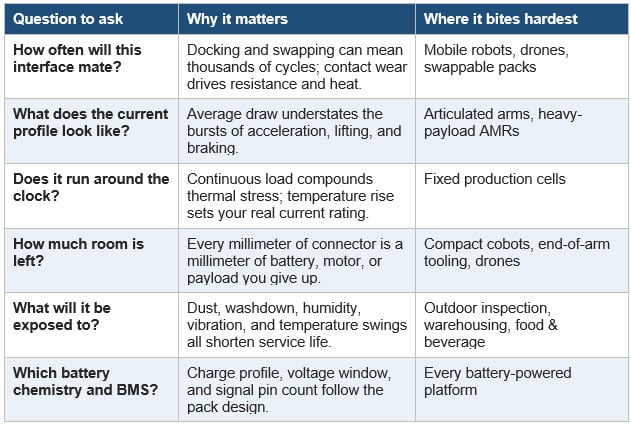
Before you lock in a power connector for your next robot, run through these questions with your design team:
The Bottom Line
Robots are getting faster, lighter, and more autonomous, and the power path has to keep up. Whether you are designing a drone that charges itself, a warehouse fleet that swaps batteries on the fly, or an assembly arm that never clocks out, the connectors at each handoff deserve the same attention as the battery and the motor.
Amphenol’s portfolio covers that full path, spanning a wide range of currents and voltages, pairing power with signal contacts, and adding features like thermal management, so each link in the chain is as reliable as the robot it powers.
Shop the Products
Acerca de este autor

Amphenol Communications Solutions, a division of Amphenol, was established through the alignment of Amphenol FCI (AFCI) and Amphenol IT Communications Products (AITC) from January 2017. The new Amphenol Communications Solutions division is made up of the following Amphenol groups: Amphenol FCI, Amphenol Commercial Products, Amphenol High Speed Interconnects, Amphenol InterCon Systems, Cables on Demand, and Amphenol TCS. The new division further strengthens the design and manufacturing footprint while deepening relationships with Amphenol customers. Amphenol Communications Solutions is a world leader providing interconnect solutions for the information, communications, and commercial electronics markets.

Have questions or comments? Continue the conversation on TechForum, Digi-Key's online community and technical resource.
Visit TechForum