Settings
 Fast Delivery
 Payment Types


 Marketplace Product

Building a Connected Motion Control System from Controller to Terminal
Contributed By DigiKey
2026-10-08
Sensors give an automated plant its eyes and ears, but motion and control supplies the heart and mind. On today’s production floor, what you notice is movement with no hand on the lever; pallets crossing the length of a warehouse, parts turned and positioned at each station, fluids pushed through long runs of pipe. But behind what you see is an intelligent chain of hardware that decides, commands, switches, and drives every movement. Controllers are moving out of the central cabinet and closer to the process, drives are getting more work out of each kilowatt, and even contactors and motor starters now report on their own condition. Whether designing machinery, assembling control panels, or managing production lines, there is now equipment that is smarter, more efficient, safer, and quicker to install and service.
An Edge controller for OT and IT integration
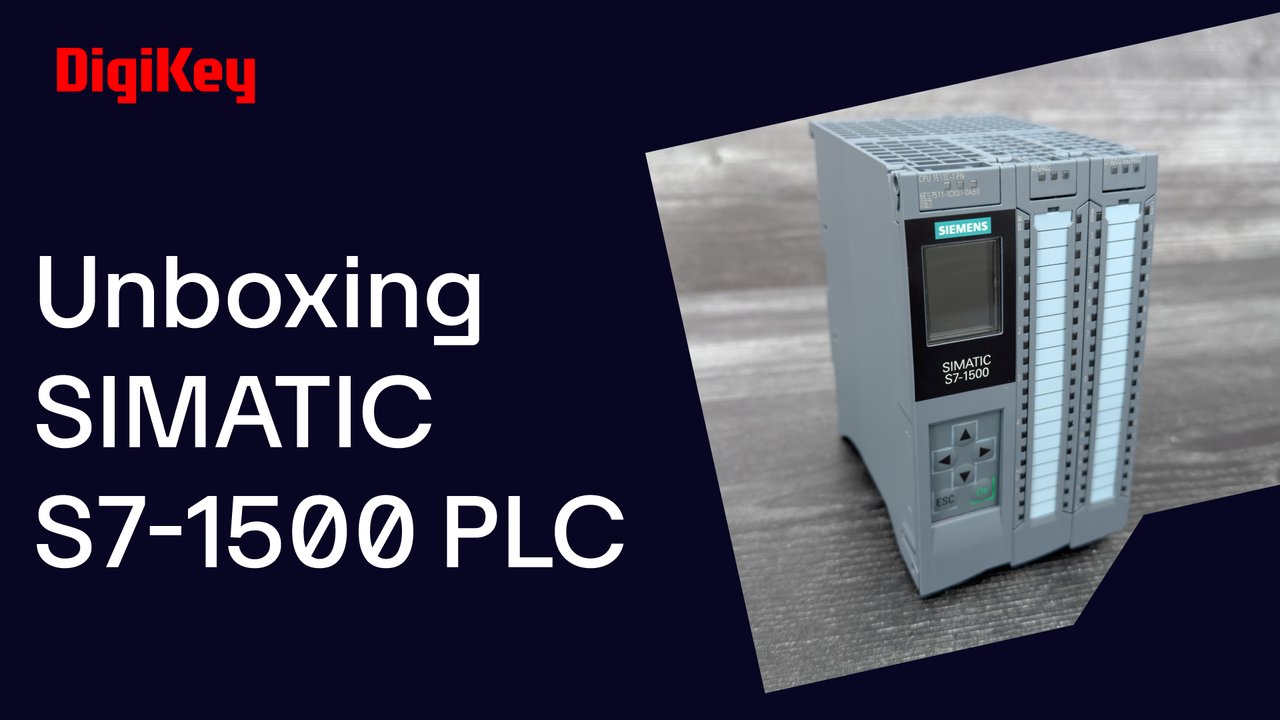
Every motion sequence begins with a decision. Siemens places that processing power directly at the machine level with its SIMATIC distributed controllers which eliminate the need for bulky centralized cabinets. These units combine the performance and engineering consistency of the SIMATIC S7-1500 family with the compact, modular design of ET 200 distributed I/O systems, allowing control to reside directly inside the I/O station itself. This decentralized design reduces cabinet space and wiring and improves system availability.
Engineering takes place within the TIA Portal, allowing distributed controllers to share the same programming languages, diagnostic concepts, and system functions as a central S7-1500 PLC. This consistency allows the designer to standardize a single controller architecture across a machine portfolio. For hardware flexibility, compact cabinet-mounted versions serve the ET 200SP, while rugged, IP65/67-rated controllers for the ET 200pro mount directly on the machinery, providing cabinet-free installations. The platform scales from basic machine control to safety-integrated and motion-centric designs using standard, failsafe (PROFIsafe), and technology variants. These technology variants place control intelligence right beside the drives and actuators they coordinate.
Bridging the plant floor and the enterprise
Many modern control tasks now reach well beyond the machine. When production data needs to feed analytics platforms, enterprise systems, or the Cloud, the Phoenix Contact AXC F 1252 PLCnext Control connects OT/IT systems from a single controller (Figure 1). It operates on a real-time Linux OS to execute time-critical processes deterministically, while allowing you to combine classic IEC 61131-3 PLC programming with high-level languages, like C++, C#, and Python. This open architecture allows control engineers and software developers to collaborate on the same application, each working in their preferred language.
 Figure 1: The Phoenix Contact AXC F 1252 PLCnext Control connects OT/IT systems from a single controller. (Image source: Pheonix Contact)
Under the hood, a dual-core Arm Cortex-A55 processor running at 1.7 GHz delivers headroom for Edge computing. The controller connects to existing plant networks through industrial protocols, such as PROFINET, Modbus TCP/RTU, and EtherNet/IP, while reaching IT systems through OPC UA, HTTPS, SQL, and direct connections to Proficloud and other Cloud platforms. The development process is certified in accordance with IEC 62443-4-1, and Phoenix Contact is preparing the product for compliance with the EU Cyber Resilience Act (CRA).
Variable frequency drives for pumps, fans, and HVAC
When a controller issues a command, a drive converts it into controlled rotation. Drive efficiency is crucial in continuous, around-the-clock infrastructure applications. Engineered specifically for pumps, fans, and compressors, the Siemens SINAMICS G120X (Figure 2) offers power ratings up to 700 hp (630kW). It is suited for use in induction, permanent magnet synchronous, and synchronous reluctance motors.
 Figure 2: The Siemens SINAMICS G120X offers power ratings up to 700hp (630kW). (Image source: Siemens)
With an operating efficiency reaching 98% and a fundamental power factor of 0.96 to 0.99, the G120X can considerably lower the total cost of ownership (TCO) across water, wastewater, and HVAC installations. Safety and ruggedness are built directly into the hardware with a SIL3-rated Safe Torque Off (STO) and short-circuit current ratings of up to 100 kA. It integrates directly into industrial and building networks through multiple protocols, including PROFINET, EtherNet/IP, Modbus, BACnet, and PROFIBUS.
For the field technician, the drive offers integrated application functions designed to protect and optimize pump and fan systems. Deragging clears clogged pumps, dry-running and cavitation protection guard the equipment, and multi-pump control coordinates pumps that share a system. Fire mode supports emergency operation, while sleep and bypass modes and built-in energy calculators help you manage consumption. Digital health monitoring with SINAMICS CONNECT 300 and Analyze MyDrives extends that intelligence into predictive maintenance, so you can catch developing problems before they interrupt service.
Commercial buildings need similar machine intelligence but tailored for a different footprint. For example, the ATH230 drive from Schneider Electric’s Altivar HVAC ATH200 range was built for heating, ventilation, and air-conditioning systems. Schneider designed its operating characteristics to optimize the mechanical, electrical, thermal, and automation layouts of control panels. The drive provides motor flexibility, supporting asynchronous motors across the IE2, IE3, and IE4 efficiency classes as well as permanent magnet synchronous motors. To streamline deployment, the drive features integrated motor protection and embedded Modbus serial and BACnet MS/TP communication, with BACnet/IP available through an optional module. These features help simplify commissioning and daily operations for HVAC contractors and building maintenance teams.
Motor starters that report operating data
The switchgear sits between the drive and the power distribution system. Siemens’ SIRIUS Modular System provides the components required to switch, protect, control, and monitor motors across frame sizes S00 to S12, supporting loads from fractional horsepower up to 400 hp at 460 V. This portfolio is backed by over 50,000 combination tests and approvals for global deployment. For panel assembly, pre-assembled motor starters up to 20 hp at 460 V reduce build times, while the SIRIUS’ 3RV29 infeed system, which installs almost without tools, distributes power up to 63 A and eliminates power feeder wiring.
The main technological advancement in this lineup is the SIRIUS 3RC7 intelligent link module, which integrates standard switchgear directly into the automation architecture. Interfaced with the SIMATIC ET 200SP, it connects S00 and S0 load feeders up to 32 A to the higher-level controller, with up to 16 modules per ET 200SP interface and no need for address configuration or a PC when a device is replaced. The 3RC7 module records electrical variables like voltage, current, phase asymmetry, and the number of overload trips, and reports them to the controller. This data supports faster error detection and lets a maintenance team schedule work around the actual condition of the equipment.
Tool-free terminations for faster panel builds
Advanced machine intelligence offers little practical value if a control panel takes too long to assemble. Schneider Electric addresses this bottleneck with its TeSys Deca SNAP IN (Figure 3) range of contactors, control relays, manual motor starters, auxiliary contacts, and wiring devices. By integrating SNAP IN connection technology developed by Weidmüller, the system allows stripped flexible and fine-stranded conductors to connect securely without tools or wire end ferrules. According to both companies, this toolless approach can cut motor control installation times by up to 75% for OEMs and panel builders in North America.
 Figure 3: Schneider Electric's new TeSys Deca contactor, featuring Weidmüller's SNAP IN connection technology, enables toolless, ferrule-free wiring that can cut motor control installation time by up to 75%. (Image source: Schneider Electric)
Each terminal is delivered with a preloaded spring that releases when the inserted conductor reaches the contact point, providing immediate acoustic, haptic, and visual confirmation through a distinct ‘click’ once the wire is correctly seated. This clear feedback removes uncertainty for less experienced technicians, and because spring force does the clamping, there is no screw torque to set. Once locked, maintenance-free spring terminals remain secure even under strong shock and vibration, avoiding the need for routine screw retightening over the lifespan of the equipment. Moreover, since the preloaded terminals require only minimal insertion force to lock, the design naturally supports automated control cabinet assembly as panel builders transition toward robotic and cobot-assisted wiring.
Planning the next motion control upgrade
Decision-making is spreading across the machine footprint while remaining securely connected to the enterprise network. Drives extract more useful work from every kilowatt-hour, while basic contactors and circuit breakers, once equipped with an intelligent link module, now report on their operating condition. If an engineer designs, builds, or maintains automated equipment, the practical results are shorter build times, less downtime, and architectures that adapt when production requirements change.
DigiKey stocks the entire portfolio of controllers, drives, and intelligent switchgear components covered in this article.

Disclaimer: The opinions, beliefs, and viewpoints expressed by the various authors and/or forum participants on this website do not necessarily reflect the opinions, beliefs, and viewpoints of DigiKey or official policies of DigiKey.