Settings
 Fast Delivery
 Payment Types


 Marketplace Product

How Bar-Type IPS TFT Displays Maximize Graphics Potential on Space-Constrained Panels
Contributed By DigiKey's North American Editors
2026-09-24
Technical Overview: Newhaven Display bar-type in-plane switching (IPS) thin-film transistor (TFT) displays provide wide-format graphical interfaces for equipment with limited panel space. Available in 2.9, 3.9, and 6.8 inch sizes, the family combines wide viewing angles, high luminance, flexible host interfaces, and operating temperatures from -20°C to 70°C. Designers can select non-touch, resistive-touch, or capacitive-touch configurations according to the application. Interface options vary by model and include 24-bit RGB, serial peripheral interface control, low-voltage differential signaling, and MIPI Display Serial Interface. Representative devices support industrial controls, portable equipment, appliances, and point-of-sale systems while providing display area within elongated enclosures. (Overview courtesy of ChatGPT)
Consumers and professionals increasingly expect vibrant, full-color displays to convey device status and provide intuitive user interfaces across applications ranging from industrial and medical equipment to automotive dashboards and consumer electronics. However, compact or elongated control panels can leave limited space for displays with conventional aspect ratios, resulting in suboptimal layouts that constrain graphics capabilities.
Designers need compact displays with wide aspect ratios to maximize limited panel space while ensuring high readability and touch control capabilities when required.
This article discusses the challenges of maximizing display readability and graphics capabilities in space-constrained applications. It then introduces solutions from Newhaven Display and shows how they address these challenges and simplify the development of compact human-machine interfaces (HMIs).
Why compact or elongated control panels struggle with graphical displays
Graphical displays let designers communicate device information with great flexibility. Depending on the application, a single screen can show device status, measurements, warnings, menus, user controls, and more, with the information changing according to the current operating mode.
Many full-color thin-film transistor (TFT) displays use familiar aspect ratios such as 16:9 and 4:3. While common on screens and monitors, these formats pose spatial optimization challenges for control panels with wide aspect ratios. Rack systems, dashboards, and handheld products, for example, may offer ample space in one dimension but very little in the other.
When accommodating standard TFT displays, designers face two main choices: increase the enclosure size to fit a larger display or use a smaller display to maintain the product form factor. However, when text and icons are smaller and fewer parameters can be displayed simultaneously, important information can be difficult to read and may require navigating multiple menu levels or cycling through displays, which is unsuitable for applications where status indicators must remain visible.
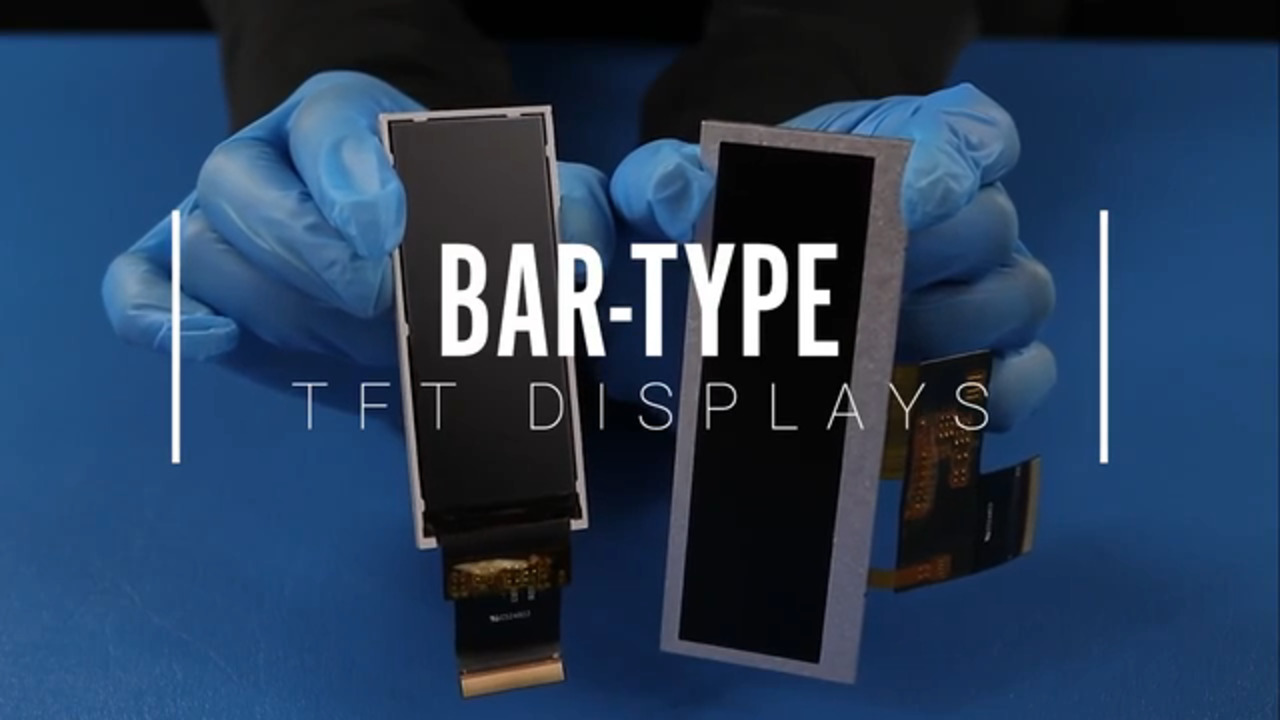
To address this issue, bar-type TFT displays offer an elongated form factor that accommodates wide or vertical control panels. This allows designers to implement larger full-color displays without increasing the panel size.
However, physical compatibility is only one challenge in effective display integration. HMIs must also remain clearly legible under the expected operating conditions. In-plane switching (IPS) addresses this requirement.
How IPS improves TFT display performance
A TFT liquid crystal display (LCD) works by changing the orientation of liquid crystals between polarizing layers, which in turn controls the amount of light passing through each pixel. How these molecules are arranged and how they move when voltage is applied depends on the LCD technology used. In IPS displays, the liquid crystals rotate in a plane parallel to the display (Figure 1). This arrangement provides more consistent optical characteristics than those of traditional TFT display technologies.
 Figure 1: IPS technology uses parallel liquid-crystal alignment to help maintain image contrast and color across wide viewing angles. (Image source: Newhaven Display, modified by Brandon Lewis)
One of the main benefits of IPS technology is its wide viewing angle, over which color and contrast remain relatively consistent. This matters for HMIs that are not always viewed head-on. In an industrial display, for example, text, graphics, or status indicators must often remain readable as an operator moves around a machine. Similarly, displays integrated into vehicles, medical equipment, or shared control systems often require clear visibility from multiple positions.
As an LCD technology, IPS also avoids the permanent burn-in mechanisms associated with emissive display technologies. This is useful for products such as industrial control panels, smart home hubs, or automotive displays, whose HMIs often display static menus, status information, or relatively fixed graphics over long operating periods.
Combining IPS technology with bar-type TFT displays helps designers address panel layout and display readability challenges for products with tall or wide aspect ratios. By selecting solutions with additional capabilities, designers can further enhance the HMI experience.
Streamlining compact HMI design with touch-capable bar-type IPS TFT displays
With 2.9", 3.9", and 6.8" bar-type IPS TFT display options, Newhaven Display lets designers maximize graphical-display capabilities on compact or elongated control panels. High brightness and contrast across the product range support readability in bright environments, including direct sunlight, while IPS technology enables 85° off-axis viewing in all four directions. The displays are also rated for operation from -20°C to 70°C, making them suitable for demanding industrial, automotive, and transportation applications.
Capacitive touch models are available across all bar-type IPS TFT display sizes, and the 3.9" form factor also offers an additional resistive touch option for greater input flexibility. This model and the non-touch models across the range also feature an anti-glare coating to further improve display readability in bright conditions.
To help protect display signals from electromagnetic interference (EMI), each display’s flexible printed circuit (FPC) includes shielding and houses the source driver and the inter-integrated circuit (I2C) capacitive touch controller (where applicable). This protection is useful for displays integrated into industrial machinery that contains or operates near motors, switching power electronics, and other potential EMI sources.
Graphical programming and display connectivity vary across the range. Each model uses a 40-pin flat flexible cable (FFC) with a 0.5 millimeter (mm) pitch for the TFT display connection. Capacitive-touch options add a separate 6-pin FFC connector with a 1 mm pitch. The 2.9" displays combine a 24-bit parallel RGB interface for pixel data with a four-wire serial peripheral interface (SPI) for initialization and register access. The 3.9" models also use a 24-bit parallel RGB interface, with user-configurable data enable (DE), synchronization (SYNC), or SYNC-DE control modes. The 6.8" models provide a high-speed display interface over user-selectable two-lane MIPI Display Serial Interface (DSI) or low-voltage differential signaling (LVDS).
Newhaven Display's bar-type IPS TFT display options enable designers to match full-color displays to the physical layout and user-interaction requirements of end-product HMIs. By examining specific displays, designers can better understand their advantages for each use case.
Selecting the right bar-type IPS TFT display
For detailed text, graphics, and status information, high pixel density and resolution are important. These requirements make the NHD-2.9-376960AF-ASXP (Figure 2) a good choice. This 2.9", non-touch display offers both high pixel density and a resolution of 376 × 960 in a compact panel footprint designed to fit horizontally within a 1U rack height.
 Figure 2: The NHD-2.9-376960AF-ASXP non-touch display provides 376 × 960 resolution for compact, elongated display applications. (Image source: Newhaven Display)
The NHD-2.9-376960AF-ASXP is well suited for industrial control panels, portable medical devices, and professional audiovisual equipment, as well as other systems where vertical panel space is limited and buttons, switches, or rotary controls are already part of the HMI.
Also designed to fit within a 1U rack height, the 480 × 128 pixel NHD-3.9-480128AF-ASXP-T (Figure 3) is the 3.9" option with resistive touch. This device enables designers to implement pressure-based touch control directly on the display, reducing the panel space required for separate physical inputs. Control can then come from a user’s bare finger, a heavy glove, or a more precise tool such as a stylus, increasing flexibility and input reliability.
 Figure 3: The NHD-3.9-480128AF-ASXP-T combines a 3.9", 480 × 128 pixel display with resistive touch, making it suitable for compact HMIs requiring direct user input. (Image source: Newhaven Display)
The touch panel specifies an activation force of 30 to 100 grams (g) and has pitting durability rated at one million touch activations and pen-writing durability rated at 100,000 characters. This robustness makes the display suitable for industrial control applications, home appliances, and point-of-sale (POS) terminals that require frequent touch input.
Measuring 6.8", the NHD-6.8-4801280AF-ASXP-CTP (Figure 4) pairs a 480 × 1280 pixel IPS TFT display with projected capacitive touch, providing more space for graphics and controls while maintaining a wide aspect ratio. The display fits within a 2U rack height, making the additional graphical area especially useful for server equipment, telecommunications systems, and rack-mounted industrial controls.
 Figure 4: The NHD-6.8-4801280AF-ASXP-CTP offers 10-point capacitive touch, enabling complex gesture-based control directly on the display. (Image source: Newhaven Display)
The touch controller supports up to 10 simultaneous touch points. This enables designers to implement multitouch interactions and software-defined gestures, such as swiping and pinch-to-zoom, enabling user interfaces that go beyond individual button-style touch inputs.
The NHD-6.8-4801280AF-ASXP-CTP’s multitouch capabilities and larger display area let designers create more complex device HMIs with fewer constraints, whether the panel layout is wide or space-constrained. In addition, IPS technology keeps these displays vibrant and readable from many operating positions.
Conclusion
Many panel applications require compact, elongated displays, wide-angle readability, and touch control. Bar-type TFT displays with IPS technology from Newhaven Display help designers maximize available panel space and enable full-color graphical interfaces that support wide viewing angles and deliver consistent image quality, while offering flexible touch integration and interface options.

Disclaimer: The opinions, beliefs, and viewpoints expressed by the various authors and/or forum participants on this website do not necessarily reflect the opinions, beliefs, and viewpoints of DigiKey or official policies of DigiKey.