Settings
 Fast Delivery
 Payment Types


 Marketplace Product

How to Scale Industrial Monitoring and Control Through Edge-Enabled HMI Platforms
Contributed By DigiKey's North American Editors
2026-07-07
As industrial applications become increasingly data-driven, operators require timely access to machine health and performance insights to improve operational efficiency. However, vast factory floors pose environmental and scalability challenges for deploying sophisticated human-machine interfaces (HMIs) across both new and existing machinery.
Developers need robust, production-ready edge platforms to accelerate and standardize HMI development for industrial applications.
This article examines the operational benefits of integrating advanced edge computing capabilities directly into industrial HMIs, as well as the technical challenges designers face. It then introduces a rugged, modular HMI solution from SECO, including an optional software framework that designers can use to accelerate application development and support long-term device lifecycle management.
Why industrial HMIs benefit from local processing
The high data demands placed on modern industrial machines create latency, bandwidth, and resilience issues when relying solely on centralized raw data processing. Beyond consolidating hardware and unifying software and data across heterogeneous platforms, integrating edge processing into HMI platforms helps developers mitigate operational continuity risks associated with remote processing.
Processing data near the source reduces latency, improves machine throughput and responsiveness, and minimizes bandwidth issues. This is important for delivering machine insights, supporting time-critical applications that contribute to operational safety, and for analysis typical of quality inspection systems. Near-source processing reduces the need to send raw data to the cloud, thereby lowering costs, especially for high-resolution image data from camera feeds.
Moving critical processing to the edge can also reduce unplanned downtime, degraded machine performance, and compromised safety during network outages. Local processing enables fully standalone operation during network outages. Centralized platforms can then provide fleet management and visibility based on information derived from localized data filtering, aggregation, and analysis within the HMI.
With the right processing platform, edge-integrated HMIs can even support artificial intelligence (AI) workloads, such as defect detection and predictive maintenance. Alternatively, AI can be used for machine access control, restricting access to authorized operators wearing appropriate personal protective equipment (PPE) and thereby improving safety and security on factory floors.
Barriers to industrialization for intelligent HMI designs
Building an industrial HMI comes with the standard challenges associated with the application’s environment. If an HMI can be exposed to dust or liquid spray, engineers must account for this by providing high levels of ingress protection. When serving as a main workstation, HMIs are unlikely to be located where operators are exposed to extended industrial temperature ranges. Still, they must offer sufficient thermal and mechanical robustness, as well as high display readability.
HMI development challenges become more complex when integrating edge processing capabilities and building systems for scalable deployment. Developers must select processing platforms that can support the application, graphics, and AI processing demands of intelligent HMIs. These platforms must also support both legacy and modern peripheral interfaces so the HMI can ingest machine data.
When transitioning to scaled deployment, projects can face sourcing and lifecycle challenges. A modular design approach provides a baseline level of standardization across units, benefiting developers. This simplifies redesign when a particular processing platform cannot be sourced or reaches end of life. Moreover, sharing a common HMI design across machines can reduce development time and cost.
Standardization also benefits HMI software. A suitable modular framework simplifies integrating parallel development efforts across application components, including data conversion and user interface code. Deployed HMIs also benefit from software infrastructure that supports centralized fleet visibility and lifecycle management, such as over-the-air (OTA) updates. These capabilities help teams track machine health across fleets and support long-term compliance throughout a deployment's lifecycle.
Designing and building a complete hardware-software framework for edge-integrated industrial HMIs requires advanced expertise across multiple disciplines. When manufacturing at scale under tight deadlines, engineers benefit from commercially available solutions that address integration challenges, allowing them to focus on competitive application development.
A production-ready solution for edge-integrated industrial HMIs
With a fanless aluminum enclosure for direct panel mounting, SECO’s Modular Vision 10.1 i.MX 95 (Figure 1) offers a compact yet powerful HMI platform that enables reliable edge processing for advanced industrial monitoring and operator interface applications. This fully integrated solution features a 10.1 inch (in.) capacitive touch display with 1280 × 800 resolution and high brightness, supporting sophisticated user interfaces with high readability under typical factory lighting.
 Figure 1: The Modular Vision 10.1 i.MX 95 panel streamlines industrial HMI development by offering a robust, edge-enabled starting point. (Image source: SECO)
From the front, the Modular Vision 10.1 i.MX 95 offers an IP66 rating, providing complete protection against dust and low-pressure water jets. This makes it suitable for standard manufacturing environments and for systems with occasional exposure to water splashes. When combined with an operating temperature range of 0°C to +60°C (+32°F to +140°F), SECO’s HMI platform delivers the ruggedness required for industrial settings.
The heart of SECO’s solution is NXP’s i.MX 95 application processor, which provides edge processing capabilities to support operational continuity through standalone HMI operation. The i.MX 95 offers an advanced heterogeneous architecture featuring:
- 6x Arm® Cortex®-A55 cores for complex data analysis, networking, and machine applications
- One Arm Cortex-M33 and one Arm Cortex-M7 core for deterministic, low-latency tasks such as timing loops for synchronized physical processes
- An Arm Mali graphics processing unit (GPU) with 2D/3D graphics acceleration for detailed visuals supporting diagnostic inspection tasks
- A neural processing unit (NPU) supporting up to 2 trillion operations per second (TOPS) for dedicated local AI acceleration in tasks such as defect detection and predictive maintenance
SECO offers the Modular Vision 10.1 i.MX 95 in two memory configurations, enabling developers to meet diverse machine requirements. The SF-E88-MDV-1621-1000-C0 integrates 4 gigabytes (Gbytes) of LPDDR5 RAM and 16 Gbytes of eMMC 5.1 storage, while the SF-E88-MDV-1411-1000-C0 offers up to 8 Gbytes of RAM and up to 64 Gbytes of storage to support demanding workloads. Both units feature soldered memory for reliable operation in vibration-prone applications.
At the rear (Figure 2), the Modular Vision 10.1 i.MX 95 platforms feature a range of physical ports for simplified interfacing with new and existing industrial communication and power lines. These include a DC-in port supporting 9 to 32 volts for flexible integration; Ethernet and CAN for communication and control network connections; and USB and serial ports for direct interfacing with sensors and peripheral systems.
 Figure 2: The Modular Vision 10.1 i.MX 95 rear panel offers connections for integrating intelligent HMI systems into industrial machinery. (Image source: SECO)
The Modular Vision 10.1 i.MX 95 streamlines HMI and edge computing integration for industrial machines by providing a ready-to-use, modular hardware platform that supports rapid prototyping, scalable production, and flexible connectivity. While these solutions are operating system (OS) agnostic, SECO offers a software framework that supports standardization, centralization, and long-term lifecycle management commitments for modern industrial applications.
HMI lifecycle management for long-term deployment success
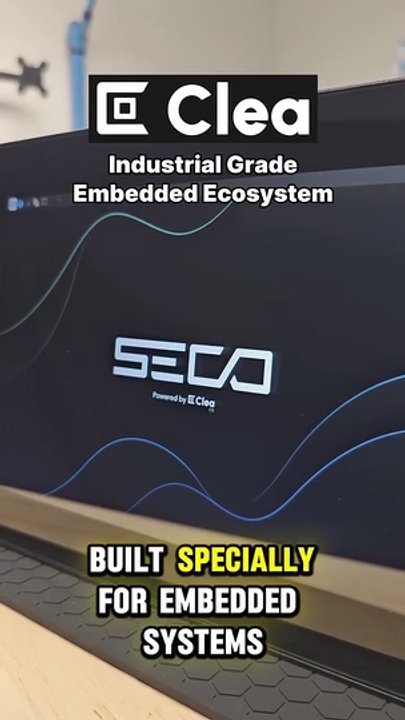
Designed for secure, industrial environments, SECO Clea (Figure 3) completes the hardware-software ecosystem for managing large-scale deployments based on Modular Vision 10.1 i.MX 95 and compatible processing platforms, enabling standardization across devices from multiple vendors.
 Figure 3: SECO’s Clea software framework offers a complete solution for building advanced industrial edge applications supported by deployment-scale infrastructure. (Image source: SECO)
For edge platforms, Clea OS provides highly customizable, modular software based on Yocto Linux. It supports secure boot and signed over-the-air (OTA) updates, and includes containerization, A/B partitioning, and rollback mechanisms to ensure operational continuity in the event of a failed update. Through Yocto, software developers gain high component traceability and build reproducibility, and benefit from automated software bill of materials (SBOM) generation, which supports long-term maintainability, compliance, and cybersecurity.
Clea OS is modular, allowing developers to remove unnecessary packages and free up resources, thereby maximizing edge processing potential. SECO also provides tools, such as the Application Hub, that accelerate AI deployment by offering a library of reference models that can be ported to compatible hardware.
The Clea cloud layer also supports device visibility and lifecycle management at scale. Clea Astarte enables data orchestration and manages secure edge-to-cloud connectivity for fleet-wide device telemetry. Clea Edgehog provides infrastructure for remote device management, configuration, and ongoing OTA updates. Finally, Clea Portal offers a ready-made toolset for building custom dashboards for centralized data visualization. By providing a complete edge-to-cloud software ecosystem for developers, SECO lowers barriers to scaling intelligent industrial HMIs.
Conclusion
When integrating edge intelligence into industrial HMIs, designers face challenges ranging from operational resilience to complex edge data processing. Scaled deployment introduces additional long-term sourcing and lifecycle management concerns. The SECO combination of Modular Vision 10.1 i.MX 95 and Clea software addresses many of these challenges with production-ready hardware and software. Furthermore, SECO’s baseline supports flexible integration with third-party solutions, promoting standardization across industrial machinery.

Disclaimer: The opinions, beliefs, and viewpoints expressed by the various authors and/or forum participants on this website do not necessarily reflect the opinions, beliefs, and viewpoints of DigiKey or official policies of DigiKey.