Settings
 Fast Delivery
 Payment Types


 Marketplace Product

Improve Industrial System Reliability with Compact, High-Density Ribbon Cables
Contributed By DigiKey's North American Editors
2026-08-11
Technical Overview: Industrial systems require compact, reliable interconnects that support dense layouts, mechanical ruggedness, serviceability, and automated assembly. This article explains how flat ribbon cable and insulation displacement contact (IDC) technology simplify power and signal routing in confined spaces. It examines the 3M 451 series socket assemblies and mating 452 series printed circuit board (pc board) headers, including their contact options, polarization, latching, strain relief, and surface-mount configurations. It also shows how the 45110-010030 receptacle, 3448-45110 strain relief, 3754/10 ribbon cable, 3640 benchtop manual press, and 3443-82-10 locator tool form a repeatable cable assembly process. Compatible 45210-220230 and 45210-200230 headers provide latching and push-pull options for the completed pc board connection. (Overview courtesy of ChatGPT)
Industrial designers face growing pressure to shrink designs while maintaining high operational performance and mechanical ruggedness. As component densities rise within limited board space, designers need reliable, compact, wire-to-board connectors compatible with automated assembly processes that support manufacturing efficiency, predictability, and first-pass yields while reducing defects. They also need robust interconnect solutions that minimize the connector footprint and maximize design flexibility in complex internal product assemblies.
For many industrial applications, the solution lies in flat ribbon cables and insulation displacement contact (IDC) technology, which enable reliable connections in space-constrained industrial designs.
This article discusses the connectivity challenges facing industrial system designers. It then introduces compact industrial interconnect and tooling solutions from 3M and shows how they can be used to create robust, repeatable assemblies that address these challenges.
The interconnect challenges of modern industrial equipment
In highly integrated designs, limited space can increase the complexity of power and data routing between different parts of a system. These interconnects are typically established using cable assemblies, which must provide reliable connections whether they are routed through confined spaces or used in applications where movement or repeated mechanical stress is present, for example, in robotics, automation, and multi-axis machinery.
While connection reliability is essential for continuous operation in harsh industrial conditions, serviceability and flexible integration are also important considerations. Industrial systems often require maintenance and upgrades throughout their operational lifetime, so the choice of cable assembly and printed circuit board (pc board) header can determine how easily these tasks are performed. This is especially true in space-constrained enclosures.
Simplifying industrial connections with ribbon cable and IDC technology
Ribbon cable provides designers with a compact, efficient solution for routing multiple wires between pc boards, displays, sensors, and other components of industrial systems. The flexibility and flat profile of ribbon cable make it well suited for establishing connections that are separated by varying distances or routed through narrow gaps.
Because ribbon cable features multiple conductors that remain aligned in a well-defined arrangement, it allows designers to easily route signal groups without needing to manage multiple discrete wires. This grouped conductor arrangement improves installation and servicing consistency when space is limited. Using these cables, designers can maintain organized cabling layouts without additional ties or harnesses.
When terminating ribbon cables, IDC technology offers a practical way to simplify connections (Figure 1). The approach uses small, sharp contacts to pierce ribbon cable insulation and establish a connection, eliminating the need to strip and terminate each conductor individually.
 Figure 1: IDC technology provides an efficient way to penetrate ribbon cable insulation and form electrical connections between grouped conductors. (Image source: 3M)
By establishing all conductor terminations in a single press operation, IDC accelerates cable assembly. With the right tools, the process is highly repeatable, improving consistency across cable assembly runs and enabling designers to match cable lengths to the physical layout of individual systems.
For industrial designs, the combination of compact ribbon cable and IDC termination increases flexibility when connecting electronics in confined spaces. With the right approach, ribbon cables can also be configured with multiple sockets along the cable length and support split routing to different circuits where appropriate. This allows a cable assembly connected to the main logic board, for example, to branch to multiple points throughout the system, reducing the total number of cables and pc board headers. In turn, this creates more space for components, increasing device functionality.
When connectors, cables, and assembly processes are designed as a complete ecosystem, designers can improve the consistency and repeatability of manufacturing processes. 3M offers a wide range of industrial pc board design and assembly solutions that provide this advantage, supporting manufacturing at scale and reducing the potential for defects.
Compact, reliable interconnect solutions for high-density industrial designs
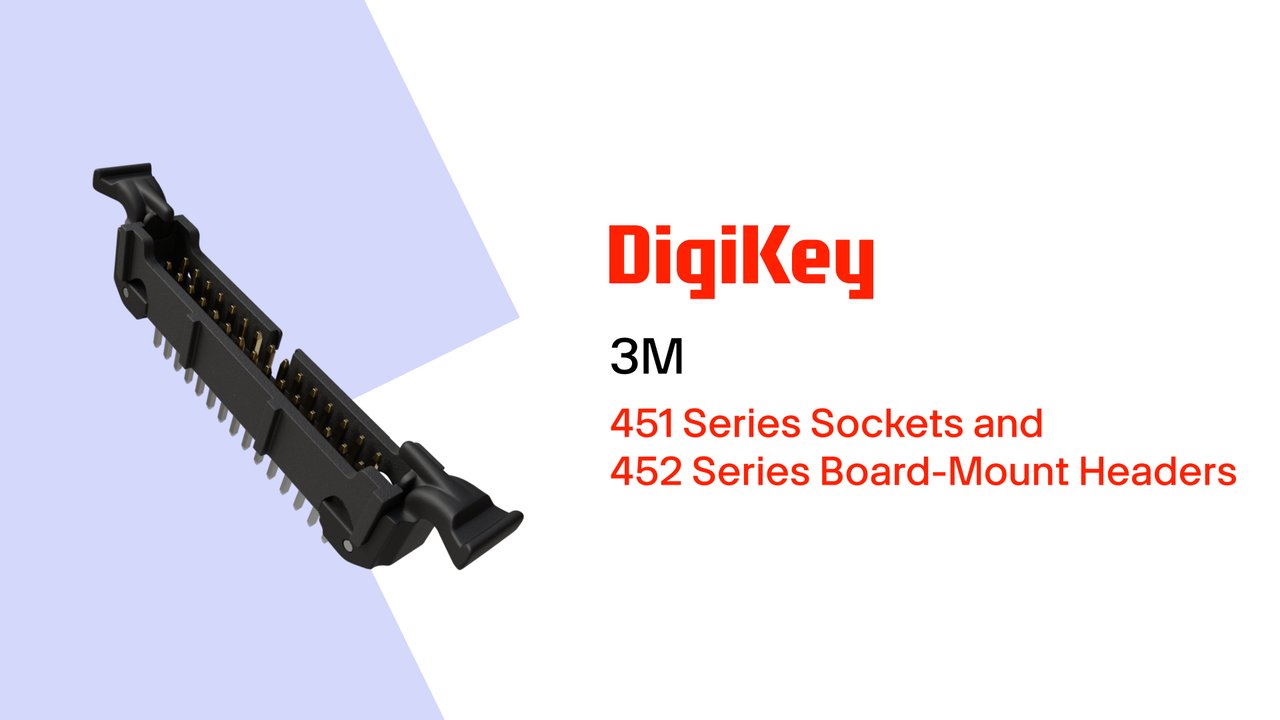
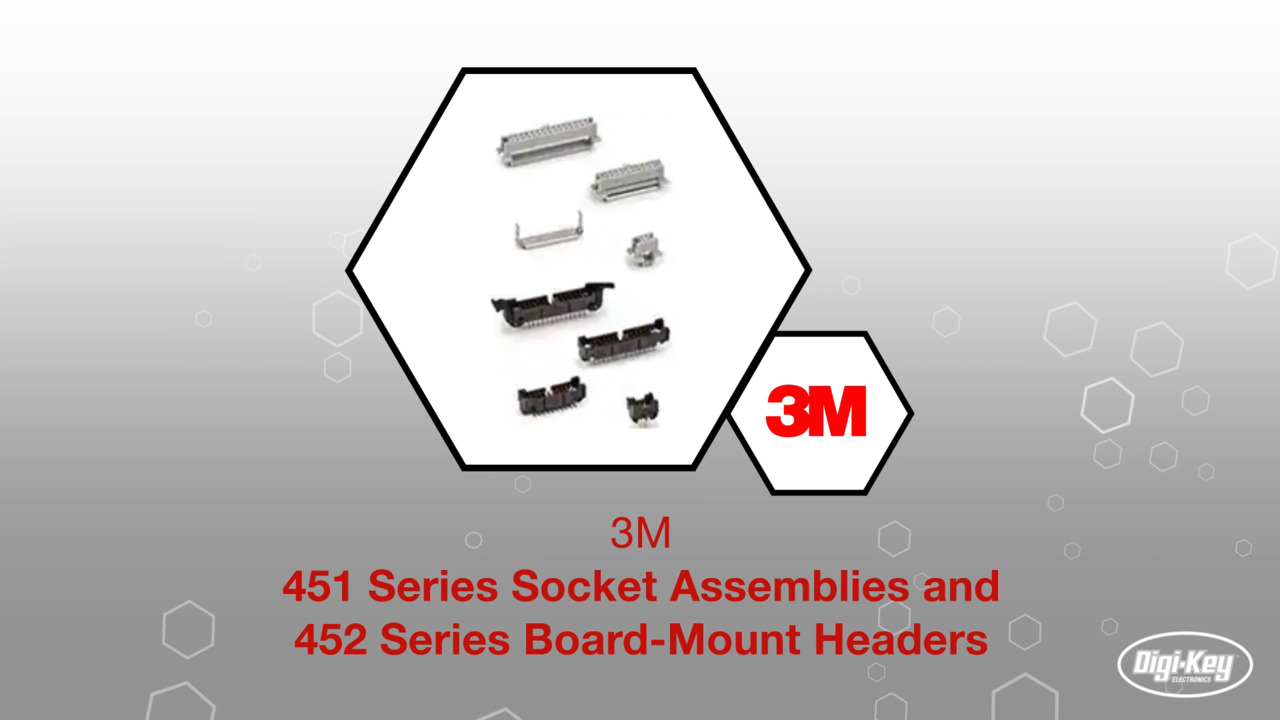
The 451 series socket assemblies and 452 series board-mount headers from 3M (Figure 2) offer designers an interconnect solution that minimizes pc board space requirements with a 1.27 mm pitch. They are available with 4, 6, 8, 10, 12, 14, 16, 20, 26, 30, 40, or 50 gold-plated contacts for reliable connections.
 Figure 2: The 451 series socket assemblies (right) and 452 series board-mount headers (left) offer a wide range of options for wire-to-board interconnects. (Image source: 3M)
By offering a range of pin counts in combination with 125 VAC and 1 A electrical ratings, the 451 and 452 series support flexible connection options, from low pin-count, low-voltage sensor arrays to complex multi-channel control and data acquisition systems.
The 451 series socket assemblies are available with polarization features to prevent incorrect mating, and friction-latch options help prevent accidental disconnection. Optional strain relief provides additional mechanical support at the IDC termination, supporting robust, reliable operation in applications where cables are subject to movement or strain during installation and servicing.
At the board level, the compact footprint of the 452 series headers preserves pc board area for additional components or signal routing, increasing design freedom on densely populated boards. The series also includes latching header variants for added connection security. In these variants, the latch mechanism doubles as a built-in ejector to ease demating and minimize the risk of connector or cable damage during maintenance or upgrades.
To support automated pick-and-place assembly and integration with existing pc board production processes, the 452 series includes surface-mount options supplied in tape-and-reel packaging. Integrating connectors directly into automated pc board assembly enables faster, more reliable manufacturing and establishes consistent methods for installing the board-side interconnect across production runs. This also reduces the need for separate manual connector placement.
In addition to robust mechanical designs, the 451 series socket assemblies and 452 series board-mount headers offer a wide operating temperature range from -65°C to +125°C, enabling use across many demanding industrial environments. UL 94 V-0 flammability performance further supports use in applications where material combustibility is a risk. However, final performance depends on the selected ribbon cable. As demonstrated below, 3M supports IDC ribbon cable assembly with specialized tooling that promotes repeatable manufacturing.
Building a ribbon cable ecosystem with ready-made solutions
In complex industrial systems, designers often need to integrate multiple logic boards and modules, such as liquid crystal displays (LCDs), power supply units (PSUs), and sensor arrays. A small serial peripheral interface (SPI) LCD, for example, typically requires a 10-pin connection carrying power, SPI communication, register select, and additional signal lines. By selecting the following components from 3M, designers can rapidly assemble a compact solution for routing these connections.
At the ribbon cable termination, the 451 series 45110-010030 (Figure 3, left) provides a 10-position rectangular receptacle connector. If required, the 3448-45110 (Figure 3, right) connector strain relief provides additional mechanical robustness, which is useful when the ribbon cable must be folded as it is routed between the LCD assembly and other pc boards.
 Figure 3: The 45110-010030 connector (left) offers cable-end or feedthrough IDC termination, with optional strain relief using the 3448-45110 (right). (Image source: 3M)
The 451 series socket assemblies are compatible with several 3M ribbon cable families. For example, the 3754/10 is a polyvinyl chloride (PVC) 10-conductor cable from the 3M 3754 series of flat ribbon cables. The series features a red conductor mark to indicate pin 1, is rated for 30 V, and has an operating temperature range of -20°C to +105°C, supporting industrial applications. The 3754/10 is supplied in a 300' spool, allowing designers to assemble custom-length cables to meet their application requirements.
When combining the 3754/10 cable with the 45110-010030 connector, the 3M 3640 benchtop manual press tool (Figure 4) provides a controlled method for IDC termination. When assembling this cable, designers will also require the 3443-82-10 10-position locator tool for precise alignment.
 Figure 4: The 3640 benchtop manual press tool provides a convenient and reliable way to terminate IDC connectors on ribbon cable. (Image source: 3M)
Now that a 10-position cable assembly has been created, designers can select a compatible 10-position 452 series connector header for the pc board. A good example is the 45210-220230 (Figure 5). This surface-mount latching option provides enhanced retention and controlled demating. Alternatively, the 45210-200230 header offers a surface-mount push-pull solution without latches, enabling designers to support closer header arrangements.
 Figure 5: The 45210-220230 board-mount header integrates a latch mechanism to help prevent accidental disconnection when a cable is pulled or placed under tension. (Image source: 3M)
Conclusion
Ribbon cable offers a streamlined solution for signal and power routing in space-constrained industrial designs where cable folding, complex routing, and serviceability are critical. Together with the broader 3M portfolio, the 451 series socket assemblies and 452 series board-mount headers provide a compact interconnect solution that simplifies ribbon cable assembly and pc board manufacturing.

Disclaimer: The opinions, beliefs, and viewpoints expressed by the various authors and/or forum participants on this website do not necessarily reflect the opinions, beliefs, and viewpoints of DigiKey or official policies of DigiKey.