Settings
 Fast Delivery
 Payment Types


 Marketplace Product

Simplifying Discrete Power Design
2026-08-14
For decades, the fastest way to add an isolated rail to a design has been to drop in a fully packaged DC/DC module, and for a great many projects that remains the right call. A module hides the transformer, the switching controller, and the feedback network behind a single part number, and it ships already certified and characterized. The convenience has a cost, though, in unit price at volume, in fixed board real estate, and in the limited room you have to tune the converter to your exact rail, ripple, and efficiency targets. When any of those constraints become limiting, building the isolated stage from discrete parts becomes attractive, and that is the path that has typically carried the most engineering burden.
RECOM Power is addressing that burden directly by expanding beyond modular supplies into discrete power solutions, pairing its own power ICs with pre-tested, matched SMD transformers, allowing you to assemble a custom isolated converter without starting from scratch.
Transformer matching is the hard part
The main reason designing your own isolated stage is challenging comes down to the transformer. It is the central element of the converter, and getting it right means reconciling a list of interacting parameters. For example, you have the turns ratio that sets your output voltage, magnetizing inductance that governs switching behavior, the leakage inductance that drives voltage spikes and snubber losses, the saturation margin that keeps the core linear under peak current, and creepage, clearance, and insulation that determine whether the part meets your isolation rating.
A driver IC that performs perfectly well with one transformer can misbehave with another whose leakage inductance or saturation point differs, prompting engineers to spend significant time characterizing potential transformers, building prototypes, and validating the pairing across line and load before they trust it. Moreover, if you layer multi-vendor sourcing on top, where the IC comes from one supplier and the magnetics from another, the schedule and risk grows further. This is the dilemma RECOM is removing from your procurement by validating the IC and transformer combination.
A single-source, pre-validated approach
Rather than qualifying a driver against a transformer of unknown fit, you can choose a combination RECOM has already tested, which reduces compatibility risk, simplifies the bill of materials (BOM), and shortens the validation cycle.
RECOM’s IC and solutions program is highly flexible. You can purchase an IC or a transformer individually, a pre-matched IC and transformer set, or a fully customized discrete solution for higher-volume production beyond 50,000 units. This allows a prototype or a mature, cost-optimized product to draw from the same familiar building blocks, enabling a design to scale from the bench to the production line without redesign.
The driver and rectifier ICs
RECOM’s portfolio is organized around two series of power ICs, split between primary-side transformer drivers and secondary-side rectifiers. On the primary side, the RVP series provides unregulated transformer drivers for push-pull and full-bridge topologies, contained in compact packages with integrated timing and overcurrent-monitoring for a low-component-count design, making them suitable for cost-sensitive open-loop isolated converters. Also on the primary side, the RVPW series handles flyback topologies and is available with an integrated switch or with a gate-drive output for an external MOSFET. They provide a versatile feedback arrangement with three selectable modes: primary-side regulation that monitors the primary waveform and avoids an optocoupler altogether, secondary-side regulation utilizing optocoupler feedback to maintain isolation, and direct DC monitoring for non-isolated use.
 Figure 1: The RVP and RVPW series. (Image source: RECOM)
Primary side regulation is worth dwelling on, since the optocoupler is a common reliability and accuracy weak point in isolated supplies; its current transfer ratio drifts with temperature and ages over the life of the product, so regulating on the primary side removes a troublesome component.
On the secondary side, the RVS series provides synchronous rectification in three variants. The RVS variant offers basic rectification through a fully integrated full-bridge rectifier in a compact package; the RVSY variant is a high-performance synchronous rectification controller that drives an external MOSFET on either the high side or the low side; and the RVSW variant adds bi-directional control and switching for battery cell charging and discharging, as embodied by the RVSW013 (Figure 2). Synchronous rectification replaces the forward voltage drop of a diode with the low on-resistance of a MOSFET, which allows these stages to recover efficiency that would otherwise be lost as heat in the output rectifier.
 Figure 2: The RVSW013 series. (Image source: RECOM)
Matched SMD transformers
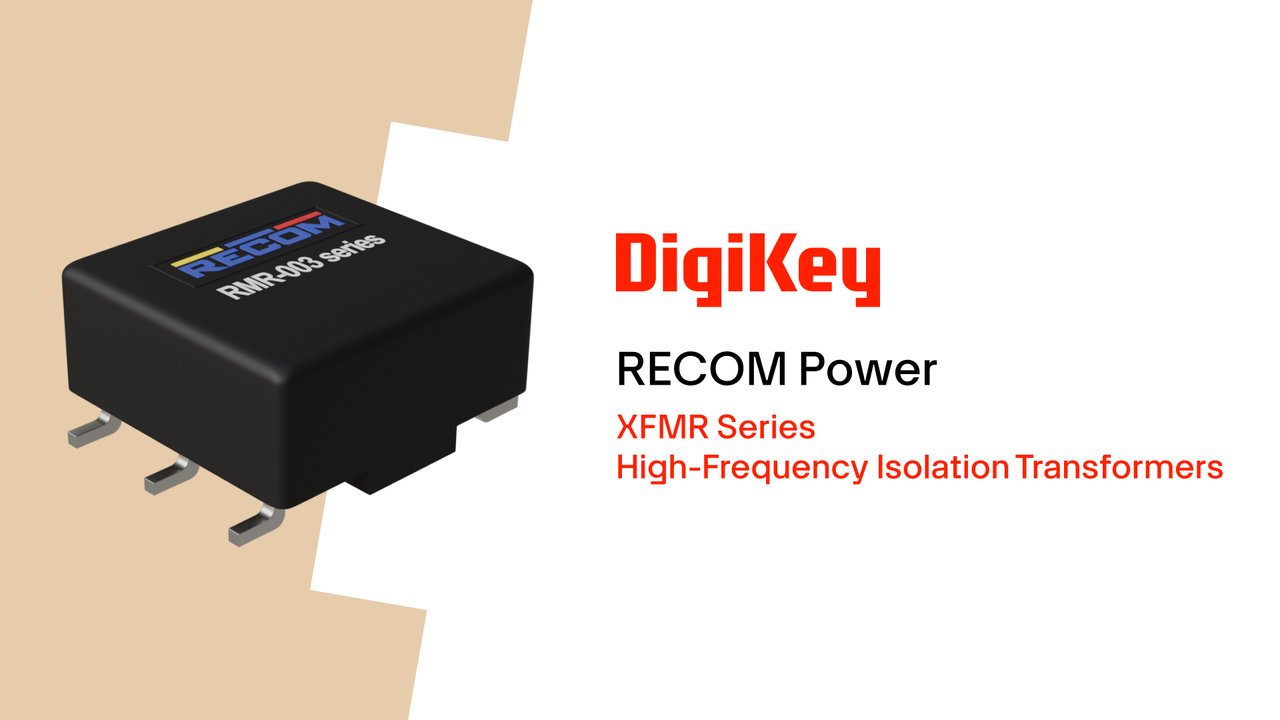
Because transformer choice is so critical, RECOM supplies a standard range of sub-miniature SMD transformers chosen to match these drivers. The RMR family covers sub-miniature 1 W and 2 W toroidal parts for push-pull and full-bridge drivers, with isolation ratings from 1.5 kVDC up to 4.5 kVDC, while the RMR-018, RMR-028, and RMR-031 raise that to an enhanced 5 kVAC rating with wider creepage and clearance for designs that need more separation. For flyback designs, the RBE family offers bobbin-type transformers from 6 W to 30 W matched to the RVPW drivers, with isolation withstand starting at 1.5 kVDC. For applications that require even greater separation, RECOM’s RPE-021 extends isolation up to 4.3 kVAC.
Across the range, the transformers support flyback, push-pull, and full-bridge drivers spanning 1 W to 30 W with isolation withstand up to 5,000 VAC. They can tolerate a reflow peak up to 250°C for as long as ten seconds and survive two reflow passes. Where a standard part will not suffice, RECOM offers custom transformers subject to a minimum order quantity.
Matching the Solution to the Power Level
It helps to keep the power tiers straight when you specify a design. An RVP primary-side driver combined with an RVS synchronous rectifier supports isolated DC/DC conversion up to roughly 10 W, which suits compact point-of-load and auxiliary rails, while the broader range built around the RVPW flyback drivers and RBE transformers extends to 30 W for high-power needs. These ICs support isolation grades from functional up to reinforced, so the same building-block design philosophy serves basic functional barriers as well as stricter separation that safety-critical equipment requires. These ICs suit a wide range of applications, from industrial, factory, and building automation to power generation, energy distribution, test/measurement, and telecom infrastructure, all environments where compact, scalable, isolated conversion is in demand.
Conclusion
Discrete power supply design no longer requires assembling and validating an isolated stage entirely on your own. By pairing characterized power ICs with matched transformers, and by offering them individually, as sets, or as custom assemblies, RECOM lets you choose the level of integration that fits your project and your production volume.
For additional information on RECOM’s current power ICs, transformer families, and related discrete solutions, please visit RECOM’s Discrete Power Solutions product highlight.
Disclaimer: The opinions, beliefs, and viewpoints expressed by the various authors and/or forum participants on this website do not necessarily reflect the opinions, beliefs, and viewpoints of DigiKey or official policies of DigiKey.