Settings
 Fast Delivery
 Payment Types


 Marketplace Product

Why Copper-Electrode NTC Thermistors Deliver More Reliable Temperature Sensing
2026-10-01
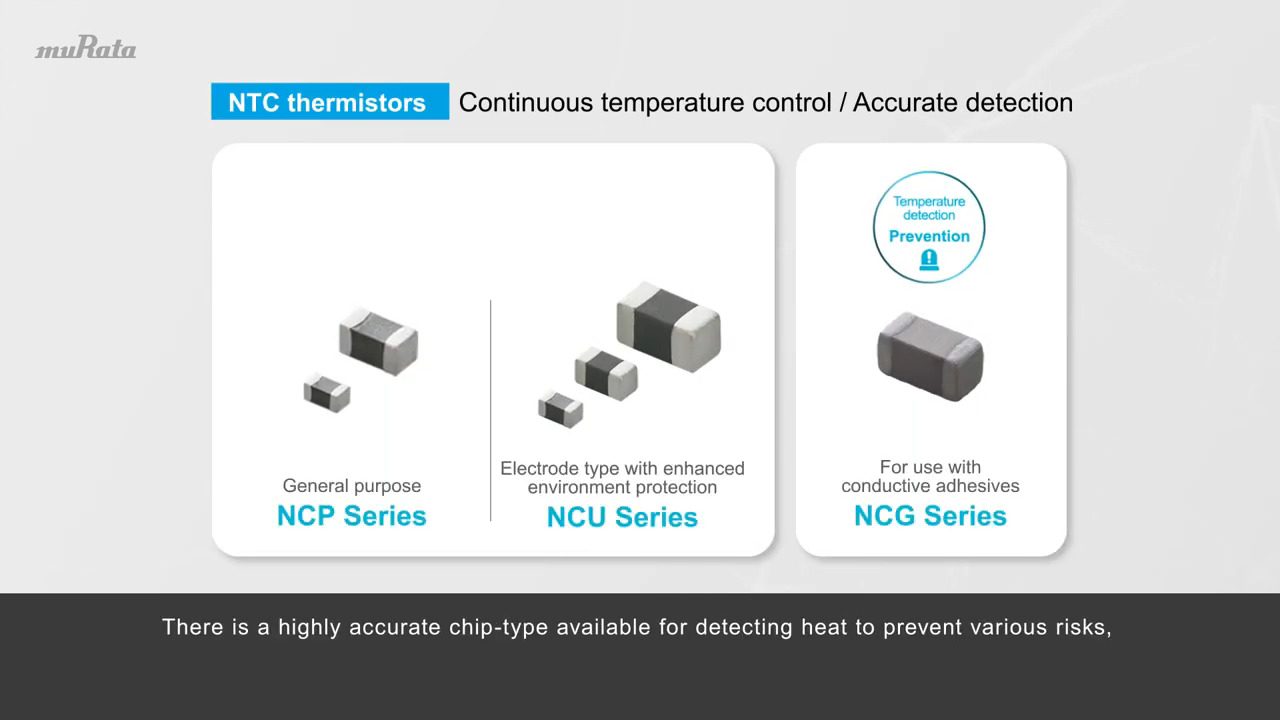
Temperature sensing is a critical requirement in nearly every electronic system today, from the battery pack in an electric vehicle to the compute board in a data center. Negative temperature coefficient (NTC) thermistors have long been the workhorse for this job because they are small, inexpensive, and highly responsive. However, these devices carry a reliability weakness in the external electrode. Murata addresses the problem with its NCU15 and NCU18 NTC thermistors which replace the silver outer electrode with a copper structure engineered to prevent chemical migration and withstand wide-ranging thermal and humidity conditions.
NCU15 and NCU18 thermistors: a copper-based solution
To understand why this design matters, it helps to look at what goes wrong with silver. When a component built with a silver-bearing external electrode operates under an applied voltage in a humid environment, the silver at the positive electrode can oxidize and ionize. Those silver ions then travel through the thin film of surface moisture toward the negative electrode where they are reduced back into metallic silver and gradually morph into conductive filaments known as dendrites. Over time, these filaments can bridge the gap between electrodes, creating leakage paths or outright short circuits. Because the electrochemical migration process is typically slow and humidity-driven, a design can pass bench tests, only to fail months later in the field.
Murata’s NCU15 and NCU18 thermistors use a copper base finished with nickel and tin plating, without any silver in the external electrode. The nickel layer serves as a diffusion barrier while the tin layer preserves solderability, so the thermistor gains migration resistance while still soldering and mounting like any standard chip component on a production line.
Murata targets automotive and other high-reliability systems with its thermistors, given that long service life under thermal and humidity stress is critical.
Note that Murata still advises against continuous use of its thermistors in condensing or corrosive-gas atmospheres. The copper electrode should be understood as removing the main electrochemical migration failure mode rather than making the device immune to every environmental stressor.
Package options and temperature range
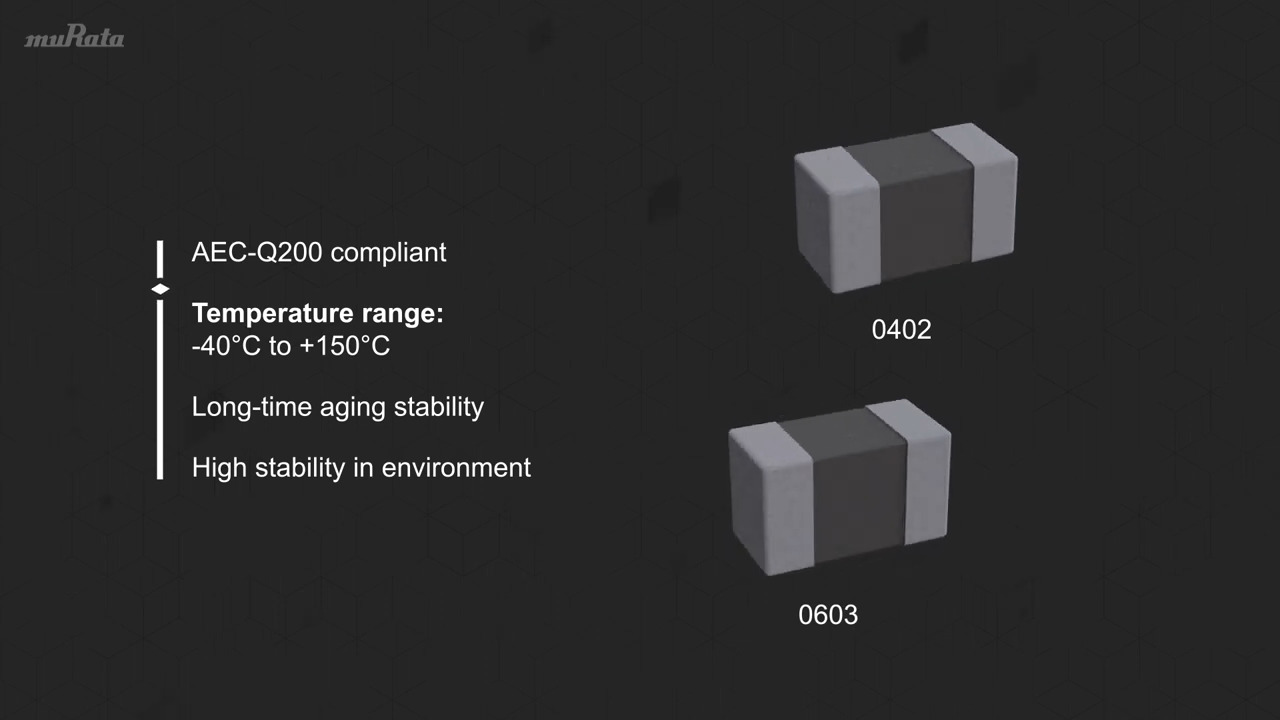
NCU15 and NCU18 thermistors are offered in compact chip formats, with the NCU15 in the 0402 EIA case size (1005 metric) and the NCU18 in the 0603 EIA case size (1608 metric) (Figure 1). Their small thermal mass is reflected in a dissipation constant of ~1.0 mW per degree Celsius which supports the thermal responsiveness required when a sensor needs to track rapid temperature changes without lagging behind the measured event.
 Figure 1: Dimensions for the NCU15 (left) and NCU18 (right) NTC thermistors. (Image source: Murata)
The thermistors cover an operating temperature range of -40°C to +125°C, with automotive-grade models extending up to +150°C for under-hood and high-temperature environments. The NCU family is UL and cUL recognized, while the automotive family is AEC-Q200 qualified.
Resistance, tolerance, and design flexibility
Murata’s thermistors offer design flexibility in a wide range of applications. They are offered in a spread of nominal resistance values at 25°C, including the common 10 kΩ, 47 kΩ, and 100 kΩ options along with higher resistances on the NCU18, each with its corresponding B-constant.
Tolerance options run from a tight ±1% for precision sensing down to more economical ±3% and ±5% grades, with a B-constant specified to ±1% on the common resistance values. This combination allows matching a specific part to your accuracy budget rather than having to over-specify. Around room temperature, the resistance of a 10 kΩ, 3380 K device changes by roughly 4% per degree, ensuring fine temperature resolution for most applications. Choosing copper over silver also carries a supply chain benefit by reducing dependence on silver, which supports a more cost-effective electrode construction without compromising sensing performance.
Key applications
Automotive electronics face some of the harshest conditions for temperature sensors. Under the hood, systems typically cycle between sub-zero cold starts and sustained high temperatures near the engine or power electronics, while EV battery packs and inverters add regular humidity exposure on top of thermal stress.
Automotive-grade NCU thermistors offer a +150°C rating to handle the upper end of the temperature range, and their AEC-Q200 qualification confirms that they have been tested against accelerated stress, including temperature cycling, humidity, and sustained high-temperature storage. The migration resistance is a key characteristic in always-on equipment, such as computing servers and factory automation systems, where sustained DC bias under continuous load is typical.
For portable designs, compact 0402 and 0603 packages and low thermal mass are key advantages. In drones, NCU thermistors monitor motor windings, electronic speed controllers, and battery cells, quickly detecting temperature increases caused by high current loads. Their short thermal time constant provides early warning of overheating, allowing the flight controller to reduce power before thermal runaway can occur.
AR/VR headsets and wearables use these compact sensors to monitor SoC, display driver, and battery temperatures, helping protect the electronics while keeping surfaces that contact a user’s face or wrist within safe limits. Distributed IoT nodes can utilize them placed next to power management or RF sections to detect thermal faults in enclosures that typically have little to no active cooling. In health and wellness wearables, the ±1 percent tolerance of the NCU15 and NCU18 series supports accuracy to within roughly a tenth of a degree around 37°C, ensuring highly accurate body temperature readings.
Conclusion
By replacing the traditional silver external electrode with a copper, nickel, and tin structure, Murata’s NCU15 and NCU18 thermistors address one of the most common long-term reliability concerns in temperature sensing: electrochemical migration. Combined with compact package options, wide operating temperature ranges, tight tolerances, and qualifications for demanding automotive and industrial environments, these thermistors provide a durable and accurate solution for dependable temperature monitoring.
Explore the entire range of NTC thermistor options on DigiKey to compare resistance values, tolerances, and case sizes to meet your specific application.
Disclaimer: The opinions, beliefs, and viewpoints expressed by the various authors and/or forum participants on this website do not necessarily reflect the opinions, beliefs, and viewpoints of DigiKey or official policies of DigiKey.