Settings
 Fast Delivery
 Payment Types


 Marketplace Product


Don't Let Power Supplies Short-Circuit Designs
Every week spent hunting for a power supply, negotiating with molding suppliers, or waiting for lab compliance results is a week lost to competitors.
Desktop and wall adapter power supplies affect more than electrical performance: they impact crucial factors such as enclosure dimensions, thermal strategy, certification planning, cable and connector decisions, user experience, serviceability, packaging, and the production ramp.
Power supply selection and integration can often be the source of late-stage bottlenecks in hardware product development. Fragmented supply chains can introduce cascading schedule risks, with dependencies across custom enclosures, specialized magnetics, PCBA scheduling, and regulatory certifications, each adding potential delays.
Teams should select the power architecture early to avoid late mechanical, regulatory, or sourcing changes. Design tradeoffs can shape the product architecture and impact market acceptance, so mechanical integration deserves the same early attention as electrical output.
For consumer-facing products, external supplies can affect usability and perceived quality through size, weight, cable stiffness, plug style, and adapter format. Power supply market acceptance can be impacted by factors such as connector orientation, cord exit direction, strain-relief requirements, mounting constraints, user access, service replacement expectations, and how the supply affects the product's finished footprint.
Preventing avoidable redesigns
Designers can narrow the field and prevent avoidable redesigns by asking a few practical questions early:
- How does the power supply impact the physical nature of the product? Enclosure size, wall thickness, mounting features, heat paths, cord exit direction, desk footprint, and service access can affect the final design.
- How will users experience the supply in real use? Adapter size, plug orientation, cable stiffness, connector feel, heat, weight, and where the supply sits can all impact perceived product quality.
- Which compliance assumptions belong to the supply, and which still belong to the finished product? Even when using certified supplies, designers still need to plan labeling, EMC behavior, market-specific requirements, and final system documentation.
- Will the same choice still work after prototype validation? Short-term availability matters early on, but production may require life-cycle support, regional plug options, predictable lead times, alternates, and customization.
- What design flexibility is needed? If volume grows, market requirements may justify different cable lengths, connectors, branding, mounting details, or packaging without redesigning the entire power architecture.
Standard power solutions
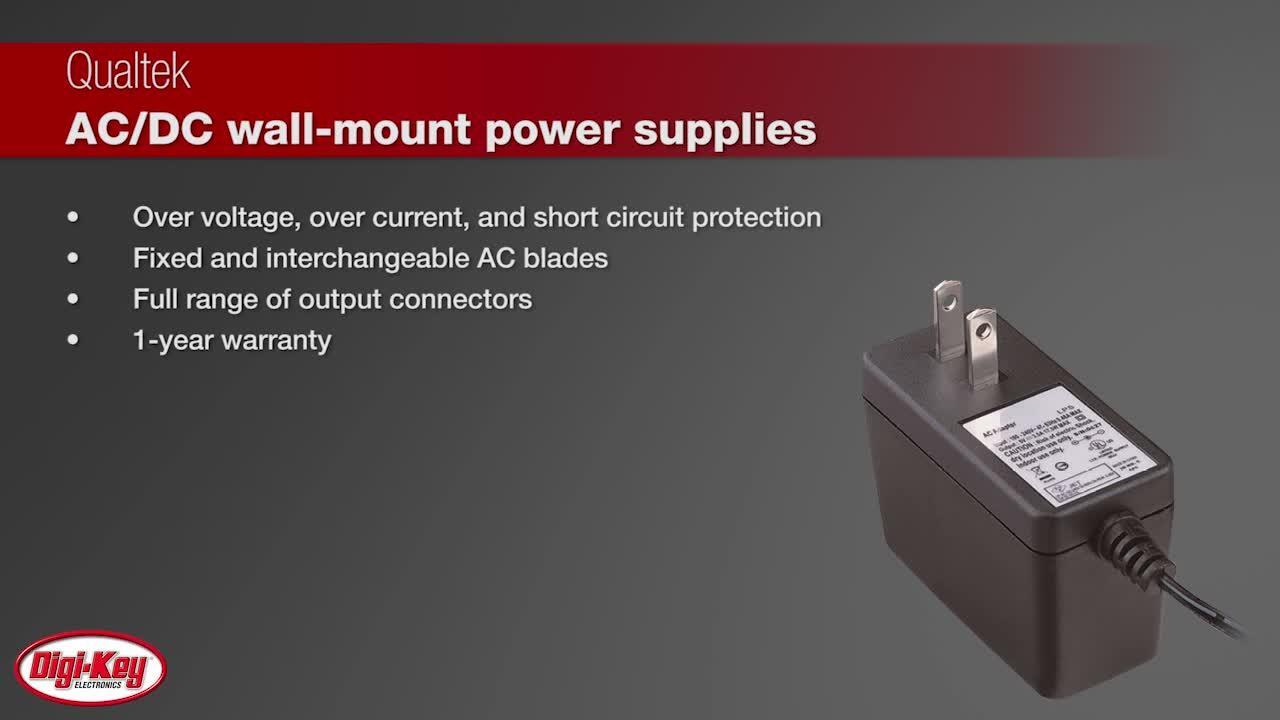
Instead of approaching every power requirement as a new sourcing and qualification effort, product designers can leverage Qualtek's standard power supply solutions for common wall-mount, USB, and desktop applications, backed by established safety and efficiency certifications. Each of the following product lines features universal AC input, Level VI energy efficiency, low no-load power consumption, and built-in output protection:
- For products that need a conventional external AC/DC supply, the QFWB series covers a broad range of common power requirements, with compact wall-mount models from 5 W through 65 W and output voltages ranging from 5 V to 24 V with short-circuit and over-current protection. One option in the family, the QFWB-30-12-US01 (Figure 1), delivers 12 V up to 2.5 A (30 W) through a standard 2.1 mm × 5.5 mm barrel connector.
 Figure 1: Qualtek's QFWB-30-12-US01 is a mid-range option in the QFWB family. (Image source: Qualtek)
- The QFWC series spans compact 5 to 10 W USB-A supplies and higher-power USB-C models up to 60 W. The QFWC-05-05 is a 5 W USB-A solution, while USB-C options like the QFWC-60-20-USCR (Figure 2) support USB Power Delivery (USB-PD).
 Figure 2: A QFWC-60 series 60 W wall-mount option with USB Type-C output. (Image source: Qualtek)
- The QADA series provides desktop power options from 18 W to 120 W, with multiple output voltages and connector configurations to accommodate product requirements where a wall-mount supply isn't appropriate. With higher power levels and a conventional IEC input, the series comes with output protection. The QADA-65-48-1401 (Figure 3) provides 48 V at up to 1.36 A (65 W).
 Figure 3: Qualtek's QADA line provides a broad range of desktop power solutions, like the QADA-65 series devices, which come with multiple output connector options. (Image source: Qualtek)
All three families accept universal 100–240 VAC input, allowing them to operate across standard mains voltages in major international markets. Available certifications include CE, CB, CCC, GS, PSE, and other regional requirements, depending on the specific model. This gives designers a range of pre-certified options when selecting a power supply for products intended for international markets.
Conclusion
An early and disciplined power supply decision can help protect enclosure work, compliance planning, manufacturing schedules, and the user experience, preventing avoidable late-stage changes. Qualtek's established, commercially available power supply platforms provide a practical starting point that supports both near-term design needs and longer-term production requirements.
About this author

Pete Bartolik is a freelance writer who has researched and written about IT and OT issues and products for more than two decades. He previously was news editor of the IT management publication Computerworld, editor-in-chief of a monthly end-user computer magazine, and a reporter with a daily newspaper.

Have questions or comments? Continue the conversation on TechForum, DigiKey's online community and technical resource.
Visit TechForumMore Blogs from this Author