Settings
 Fast Delivery
 Payment Types


 Marketplace Product


How to Quickly Implement Bluetooth Channel Sounding for Improved Positioning
Misplacing a specific piece of equipment in your personal workshop is a frustration for many of us, often causing delays. In deployment-scale settings, however, losing track of equipment and other assets can be highly detrimental to productivity and carry a high cost.
For years, Bluetooth positioning has helped teams locate and track devices across many applications, using methods such as received signal strength indicator (RSSI) beacons for presence detection and angle-of-arrival (AoA) setups for direction finding. The Bluetooth Core 6.0 specification builds on these capabilities with Bluetooth Channel Sounding (CS), which offers new opportunities for Bluetooth ranging when high accuracy is essential.
What is CS and how does it work?
Bluetooth CS is a technique that enables precise distance measurements between two Bluetooth devices, achieving sub-1 meter (m) accuracy. It combines two methods to improve reliability and security by detecting measurement or communication inconsistencies. The first method, phase-based ranging (PBR) (Figure 1, top), uses phase-difference measurements across multiple radio frequencies to accurately determine the distance between an initiator device and a reflector device, which send and respond to probe signals, respectively.
The second method, round-trip time (RTT) (Figure 1, bottom), uses a specialized packet exchange. The distance is then determined using time-of-flight (ToF) calculations that account for the reflector turnaround time.
 Figure 1: CS uses two methods for accurate distance estimation: PBR (top) and RTT (bottom). (Image source: u-blox, modified by Brandon Lewis)
By using these methods, CS provides improved resilience to multipath propagation (i.e., the same signal arriving over multiple reflected paths) at relatively low power consumption and cost compared with other wireless ranging technologies.
High-accuracy Bluetooth ranging enables more precise tracking and even geofencing for applications such as retail asset tracking, micromobility, medical devices, connected tools, and smart manufacturing. Bluetooth CS can also improve access-control security in smart buildings by ensuring locks open only when authorized devices are within a well-defined range. Similarly, accurate distance measurement enables smart home devices to save energy by activating only selected functions when users are within range.
Because Bluetooth is widely used in existing devices, adding CS functionality builds on established ecosystems. This means that instead of designing your own CS circuits for an Internet of Things (IoT) application, you can add CS using wireless modules that support both Bluetooth Core 6.0 and CS for your target applications.
Compact Bluetooth modules for next-generation IoT
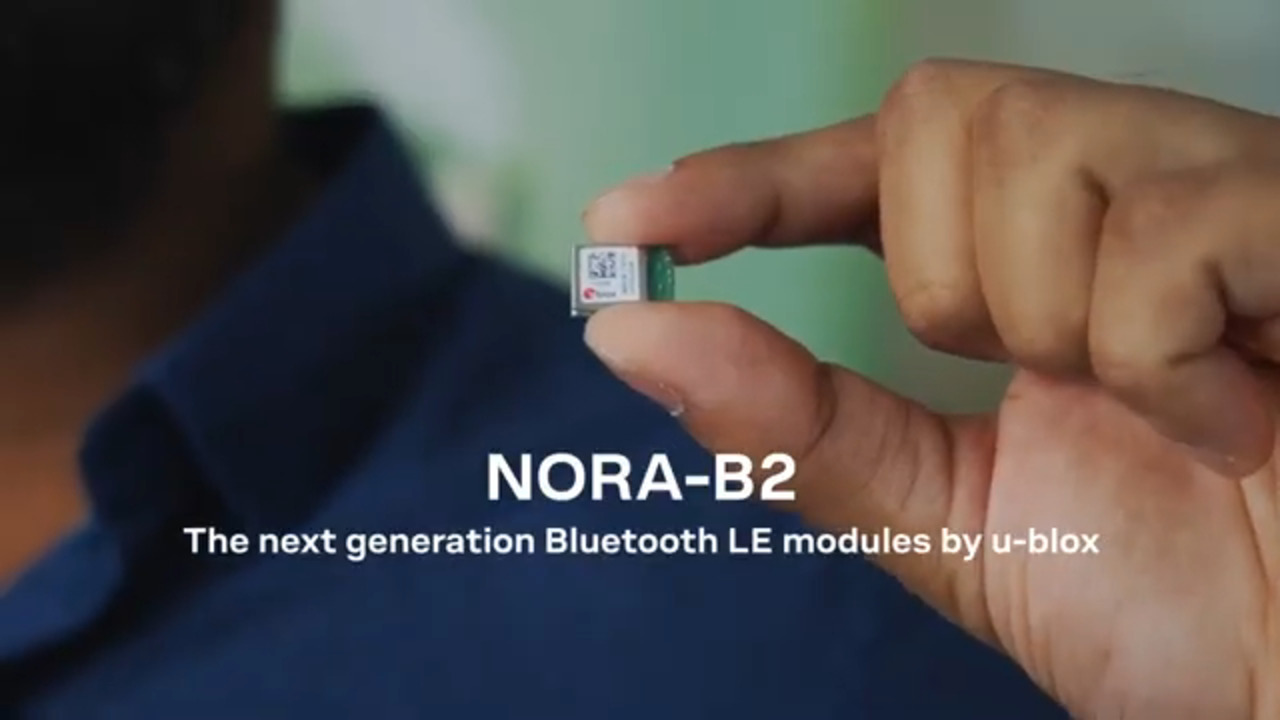
The u-blox NORA-B2 series provides highly integrated solutions for adding Bluetooth Core 6.0 functionality to new or existing designs. Designed for standalone operation in professional-grade IoT applications, these Bluetooth Low Energy (BLE) modules also support Thread, Zigbee, and Matter connectivity, depending on the model.
The series offers two compact integration options. The NORA-B201-00B (Figure 2, left) measures 11.2 × 10.4 millimeters (mm) and includes a pin for an external antenna connection. The equivalent NORA-B206-00B module (Figure 2, right) measures 14.3 × 10.4 mm and integrates a printed circuit board (pc board) antenna.
 Figure 2: The compact NORA-B201-00B (left) and NORA-B206-00B (right) BLE modules offer external and integrated antenna options, respectively. (Image source: u-blox)
A Nordic Semiconductor nRF54L system-on-chip (SoC) sits at the heart of each module. This SoC provides Bluetooth Core 6.0 connectivity and is powered by an ARM Cortex-M33 core capable of running complex applications, from kickback protection in connected power tools to data analysis on wearable health monitors. Nordic’s SoC also provides secure boot, secure storage, and tamper detection, protecting devices and stored credentials.
The NORA-B2 series provides ample flexibility for supporting diverse application requirements:
- Three memory options allow designers to scale application requirements and cost.
- Many interface options, including UART, SPI, I²C, and NFC, support peripheral versatility.
- Power input from 1.7 to 3.5 volts eases integration into existing designs.
- A -40 to 85°C temperature range enables operation in harsh industrial settings.
u-blox offers these BLE modules with global certifications and comprehensive development tools to accelerate product launches.
Quick-start Bluetooth CS development board
The EVK-NORA-B2 series evaluation kits (Figure 3) let you start building Bluetooth CS applications without custom hardware. The boards provide access to module interfaces and support connections to external sensors and peripheral expansion boards. Pin headers are provided for the 31 GPIOs, current measurement, and power input.
 Figure 3: The EVK-NORA-B2 series evaluation kits let you quickly start developing applications using NORA-B2 modules. (Image source: u-blox)
The boards can also be powered by a coin-cell battery to better simulate real-world designs. Alternatively, the USB-C port can supply power and support COM and debug operations, which can also be performed via the SEGGER J-Link port. Buttons and status LEDs are included to support immediate evaluation and application development.
For designs with a separate host processor, u-blox offers alternative NORA-B2 modules, such as the NORA-B261-00B, which come preinstalled with u-blox u-connectXpress software for out-of-the-box secure IoT connectivity. The software streamlines Bluetooth stack configuration through an easy-to-use command-line application programming interface (API). Planned support for Bluetooth Core 6.0 features, including CS, will allow developers to add this capability without prior expertise, removing a significant time-to-market hurdle for designers who are not Bluetooth experts.
Conclusion
Bluetooth CS is a standout feature of the Bluetooth Core 6.0 specification, enabling high-accuracy tracking, geofencing, and range-based interactions across a wide range of applications. The u-blox NORA-B2 series offers compact, full-featured solutions that deliver this functionality and support modern IoT applications without requiring an entirely new wireless infrastructure.
About this author

Brandon Lewis has been a technical writer and editor for over 15 years, serving as editor-in-chief at various electronics engineering trade publications. Brandon’s areas of focus include microcontrollers, multicore embedded processors, embedded Linux and real-time operating systems, industrial communications protocols, single-board computers and computer on modules, and other aspects of real-time computing. He is an accomplished podcaster, YouTuber, event moderator, conference chair, and product reviewer.

Have questions or comments? Continue the conversation on TechForum, DigiKey's online community and technical resource.
Visit TechForumMore Blogs from this Author