Settings
 Fast Delivery
 Payment Types


 Marketplace Product


Use a Dev Kit to Quickly Prototype BLE Channel Sounding Applications
The older I get, the more I misplace items. I often wish my phone’s “Find My” feature was universal, so I could track down all my missing belongings.
Bluetooth Low Energy (BLE) Channel Sounding (CS) could make this a reality. Introduced in the Bluetooth Core Specification 6.0, this distance-estimation feature is widely used for item tracking, geofencing, keyless entry, warehouse management, and pet tracking.
The benefits of BLE CS are compelling: it can achieve distance-estimation accuracy on the order of tens of centimeters (cm), incorporates security features, and is built into modern BLE chipsets. However, deploying a BLE CS solution is not without challenges: you’ll need to set up a BLE CS test bed, validate distance measurements, and debug the entire signal chain.
Out-of-the-box productivity for BLE CS development
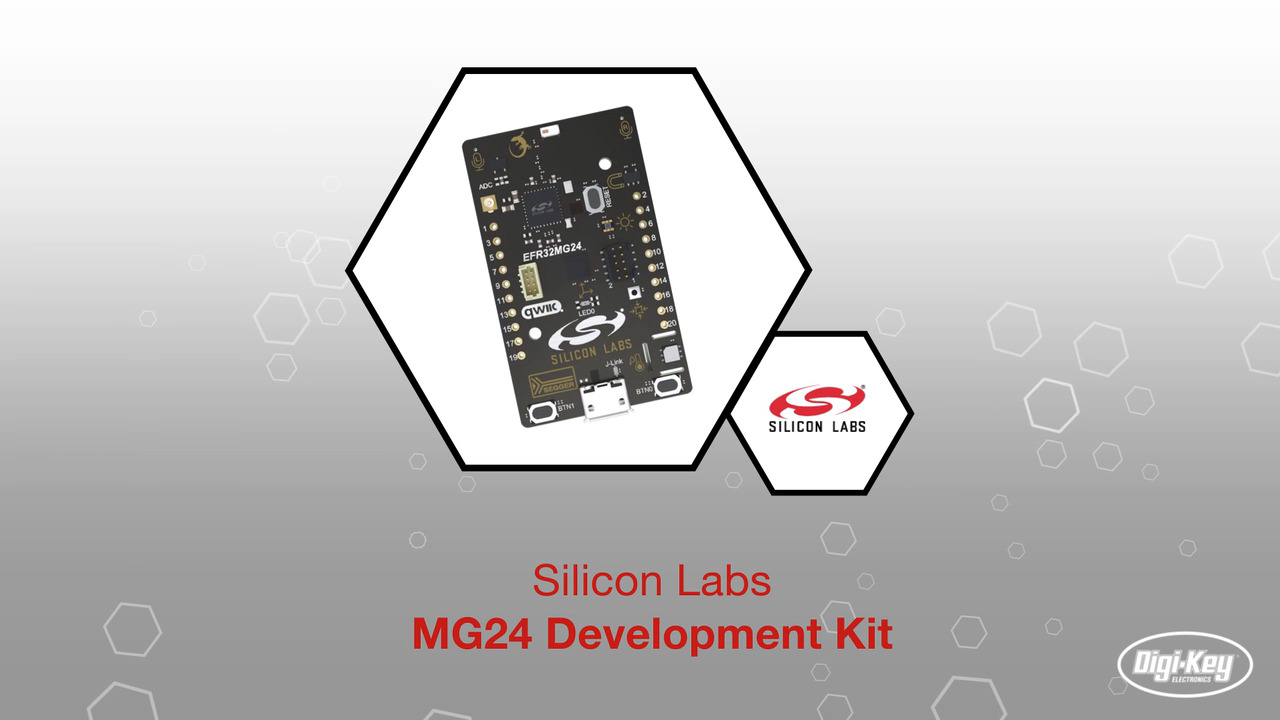
To help you, Silicon Labs has created a lineup of boards and kits to expedite the process, starting with the XG24-PK6036A EFR32xG24 Channel Sounding Pro Kit, a comprehensive platform for prototyping and developing BLE CS solutions. The Pro Kit comprises two SI-MB4002A Wireless Pro Kit Mainboards (Figure 1), each with its own XG24-RB4198A EFR32xG24 Channel Sounding Radio Board and dipole antenna.
 Figure 1: The XG24-PK6036A Channel Sounding Pro Kit comprises two SI-MB4002A Wireless Pro Kit Mainboards (shown), each with its own radio board and dipole antenna. (Image source: Silicon Labs)
Because the kit bundles two mainboards together, you don’t need to assemble compatible BLE CS nodes. Instead, you get a complete paired setup that is ready to use out of the box.
This is particularly valuable because distance estimation is inherently a two-ended process. The behavior of the initiator and reflector, the antennas, the firmware, and the analysis tools all affect the final measurement. By packaging two mainboards, two radio boards, and two antennas, the Pro Kit provides you with a known-good baseline before you modify variables such as antenna orientation, enclosure design, board layout, software settings, or operating environment.
To support BLE CS stack development, each mainboard provides Ethernet and USB connectivity, a 20-pin expansion header, and an onboard J-Link debugger with a virtual COM port and a packet trace interface. The boards are supported by tools such as Simplicity Studio, which includes a Channel Sounding Analyzer (Figure 2) for configuring and visualizing distance estimation.
 Figure 2: The Simplicity Studio Channel Sounding Analyzer offers a tailored interface for assessing BLE CS performance. (Image source: Silicon Labs)
Silicon Labs also offers the XG24-RB4198A radio board as a separate component, providing users who already have a mainboard with a straightforward upgrade path to the latest BLE technology.
The radio board is based on Silicon Labs’ EFR32MG24B210F1536IM48-B wireless SoC (Figure 3). Designed for mesh Internet of Things (IoT) wireless connectivity using Bluetooth, Matter, OpenThread, and Zigbee, this 2.4 gigahertz (GHz) radio frequency (RF) chip packs a long list of features into a 6 × 6 millimeter (mm) 48 VFQFN package. These features include a 10 decibel-milliwatt (dBm) front-end, an Arm Cortex-M33 core with 1536 kilobytes (Kbytes) of flash and 256 Kbytes of RAM, an artificial intelligence (AI)/machine learning (ML) accelerator, and Secure Vault.
 Figure 3: The EFR32MG24B210F1536IM48-B is a sophisticated wireless SoC in a 6 × 6 mm package. (Image source: Silicon Labs)
This level of integration is valuable because many BLE CS products have complex functionality. A keyless entry device, asset tag, or access-control node may also require secure identity management, local application processing, and connectivity to a broader IoT ecosystem. By integrating the radio, processing resources, and security features into a single device, the EFR32xG24 provides a direct path to a complete connected product architecture.
Developing multi-antenna and compact BLE CS solutions
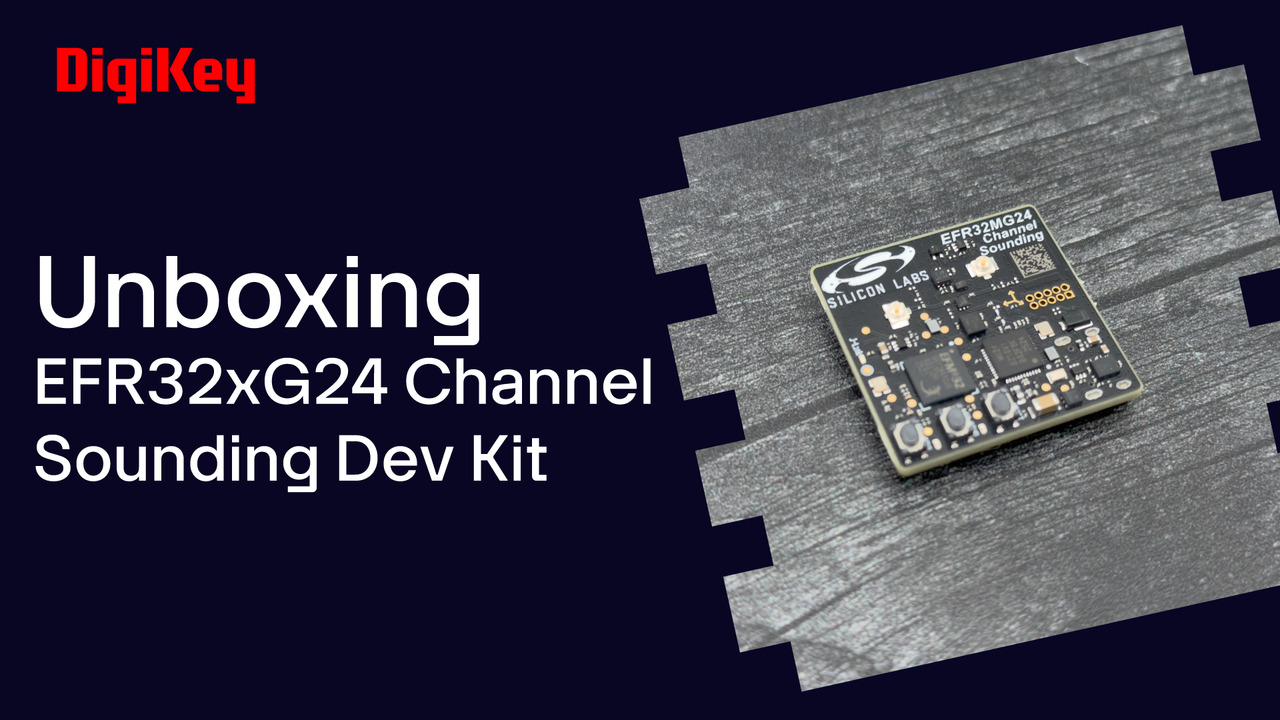
A key benefit of BLE CS is its support for multi-antenna connections, which can improve accuracy. If you’re interested in exploring this option, take advantage of the XG24-DK2606A EFR32xG24 Channel Sounding Dev Kit (Figure 4), which features dual printed 2.4 GHz antennas. Based on the same wireless SoC as the Pro Kit, the 33 × 33 mm XG24-DK2606A offers a more limited hardware loadout but retains compatibility with Simplicity Studio.
 Figure 4: Top (left) and bottom (right) views and measurements of the XG24-DK2606A EFR32xG24 Channel Sounding Dev Kit show it is a compact option for multi-antenna exploration. (Image source: Silicon Labs)
The smaller board is also useful for exploring design conditions that more closely match those of compact end products. In applications such as tags, fobs, remotes, and small access devices, antenna placement and board size can strongly influence distance-estimation performance. The kit’s dual printed antennas, U.FL connectors, USB-C interface, inertial sensor, and coin-cell holder make it suitable for experiments involving orientation, motion, battery-powered operation, and alternative antenna arrangements before a custom design is built.
Conclusion
Whether you are looking for a better way to track those easy-to-lose items or pursuing another distance-estimation application, the advantages of BLE CS are hard to ignore. The Silicon Labs channel sounding kits and the intuitive Simplicity Studio tools provide convenient options for exploring this technology and quickly getting started with BLE CS.
About this author

Kenton Williston received his B.S. in Electrical Engineering in 2000 and started his career as processor benchmark analyst. Since then he worked as an editor with the EE Times group and helped launch and lead multiple publications and conferences serving the electronics industry.

Have questions or comments? Continue the conversation on TechForum, DigiKey's online community and technical resource.
Visit TechForumMore Blogs from this Author