Settings
 Fast Delivery
 Payment Types


 Marketplace Product


Designing Trustworthy Edge AI Systems
The "edge" is at the forefront of artificial intelligence (AI) deployment as organizations move intelligence from centralized cloud servers to the devices where data is generated. The goal is to enable autonomous systems that can make fast, informed decisions without relying on a constant cloud connection. As organizations race to deploy increasingly intelligent products, they need to be trusted and secure.
Edge AI enables a new generation of intelligent products that can respond in real time, continue operating when disconnected, and scale more economically than cloud-only architectures. Protecting sensitive data is fundamental, especially for devices deployed in physically inaccessible or hostile environments. These systems must securely process confidential data while operating within strict power, performance, and memory constraints.
Every edge AI device becomes a decision maker, a data custodian, and a potential cyber target.
These applications require in-depth defense strategies that integrate security at every layer, from silicon to software, creating systems that can be trusted over years of deployment. If an edge solution leaks sensitive data or can’t be updated securely, it won't matter that it is faster, smarter, and more efficient.
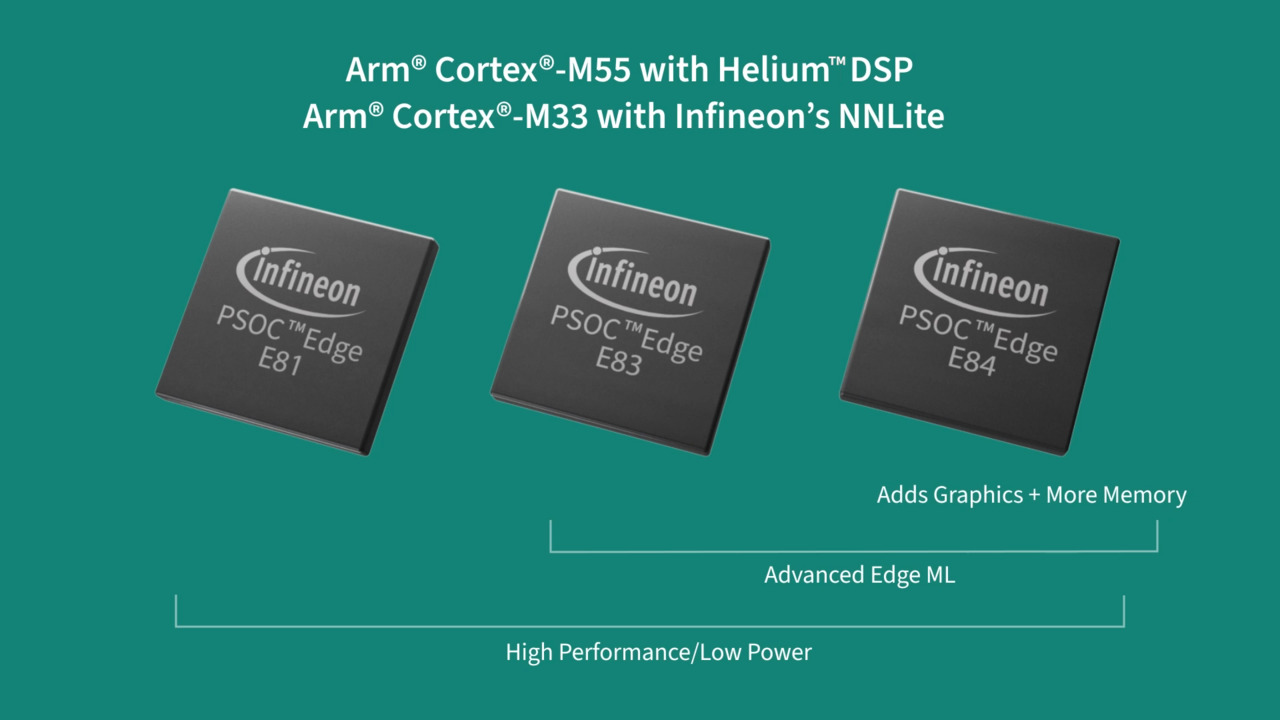
Security needs to be built into the architecture of edge AI designs as attack surfaces extend across multiple dimensions: physical security, data confidentiality, model integrity, and firmware and software integrity. Security is most effective when it is built into the system architecture rather than added late in development. Infineon Technologies embodies that concept with its PSOC Edge (Figure 1) microcontroller (MCU) platform, which brings together processing, connectivity, and hardware-based security features for embedded AI applications.
 Figure 1: Infineon’s PSOC Edge MCUs are available in multiple performance tiers. (Image source: Infineon Technologies)
The PSOC Edge family is intended for embedded systems that need local AI processing without the cost, latency, or availability concerns of sending every workload to the cloud. By pairing ARM Cortex-M33 and Cortex-M55 cores with on-chip memory and common peripheral interfaces, the devices can support application logic, sensor input, user-interface functions, and machine-learning inference within a compact MCU-based design.
Infineon's security architecture separates sensitive operations from the main application environment through a Secure Enclave. That separation can help protect functions such as authentication, cryptographic processing, and key management, which are especially important for connected devices deployed outside controlled environments.
Key PSOC Edge capabilities relevant to secure edge AI designs include:
- Secure boot and firmware protection: Devices can verify firmware before execution, helping reduce the risk that unauthorized or modified code will run on the system.
- Hardware cryptographic acceleration: Dedicated cryptographic resources can handle encryption, hashing, and authentication tasks more efficiently than software-only implementations.
- Secure key handling: Protected storage and key-management support help keep credentials and cryptographic material isolated from general application code.
- Trusted execution support: Isolated execution environments can separate security-sensitive routines from the rest of the application, limiting the effect of software flaws or compromised components.
Sensor data is crucial for edge AI systems, so ensuring integrity is vital. Tampering with sensor inputs can lead to incorrect results, safety risks, or attacks.
In practice, that means the design should not simply assume every connected sensor is legitimate or that every data stream is trustworthy. Authentication at the sensor interface can help confirm the source of incoming data, while encrypted communication can protect information as it moves between sensors and the processing core in applications that require stronger safeguards.
PSOC Edge E84 AI Kit
The PSOC Edge E84 AI Kit embedded evaluation board (Figure 2) provides developers the ability to evaluate edge AI design capabilities in a practical hardware environment while gaining access to the complete software ecosystem needed to move from concept to working prototype. The kit includes a production-ready PSOC Edge microcontroller with integrated AI acceleration hardware, delivering up to several hundred million multiply-accumulate operations per second while maintaining low power consumption suitable for battery-operated devices.
Rather than starting with a bare device, teams can use the kit to experiment with IoT, industrial control, and human-machine interface designs that must balance power, responsiveness, and protection. Developers can use associated software tools and middleware to prototype and tune edge AI functions while keeping security requirements visible throughout the development process.
 Figure 2: The PSOC Edge E84 AI Kit enables developers to validate AI models, optimize system performance, and accelerate embedded product development for edge AI applications. (Image source: Infineon Technologies)
The evaluation and development kit showcases the capabilities of the flagship PSOC Edge E84, which combines high-performance AI acceleration with advanced security features for vision, industrial, and intelligent sensing applications. Other members of the PSOC Edge family target applications with different performance, memory, and AI processing requirements, allowing developers to select the device that best matches their design objectives.
Conclusion
Infineon's PSOC Edge pre-validated components help reduce development time while simplifying the implementation of security best practices. With the PSOC Edge E84 AI Kit, developers can evaluate AI model optimization, hardware acceleration, sensor integration, secure provisioning, and application development using production-ready software tools.
About this author

Pete Bartolik is a freelance writer who has researched and written about IT and OT issues and products for more than two decades. He previously was news editor of the IT management publication Computerworld, editor-in-chief of a monthly end-user computer magazine, and a reporter with a daily newspaper.

Have questions or comments? Continue the conversation on TechForum, DigiKey's online community and technical resource.
Visit TechForumMore Blogs from this Author